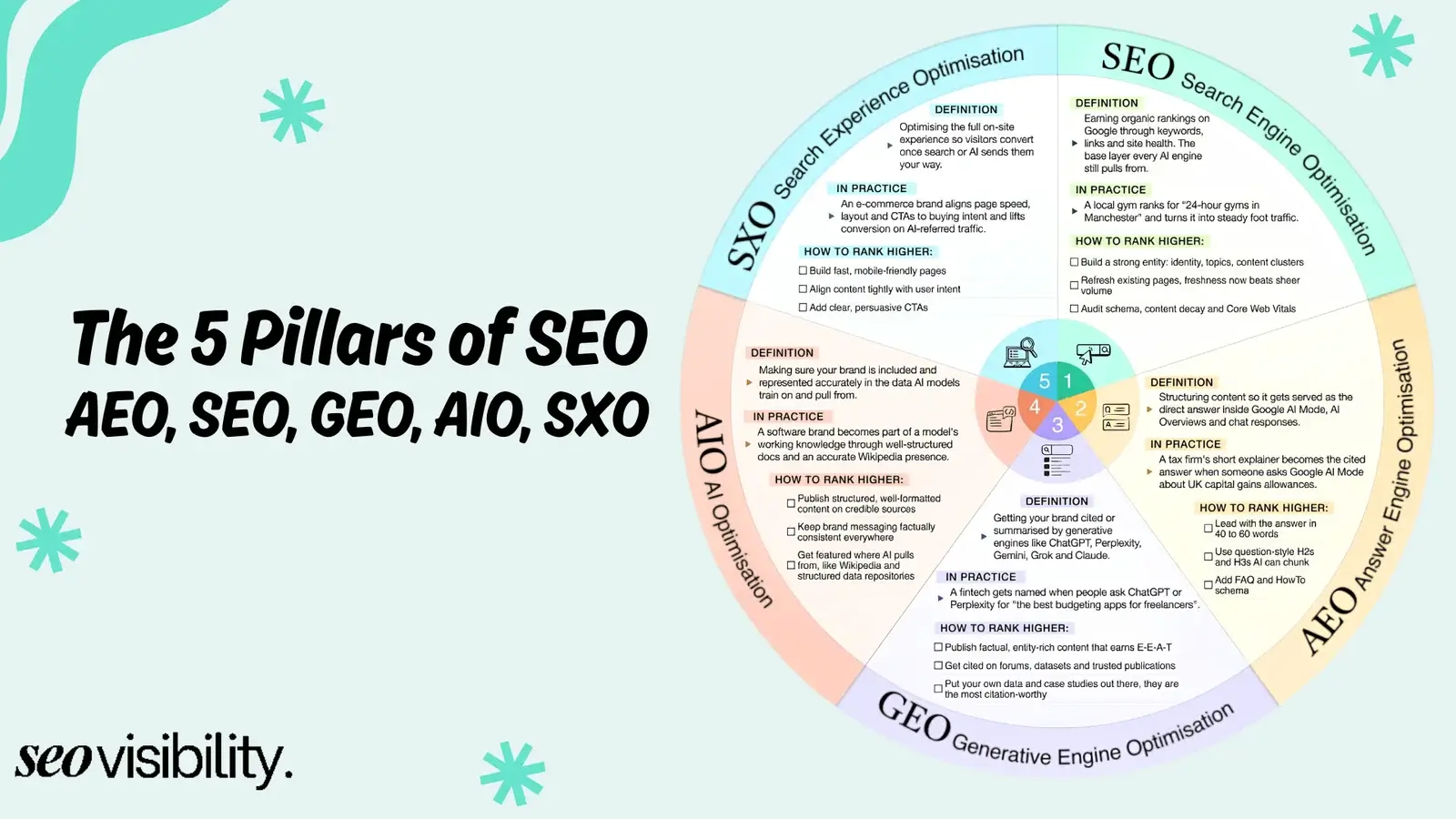
SEO in 2026 is no longer just about keywords and backlinks. It now covers five important pillars: SEO, AEO (answer engine optimization), GEO (generative engine optimization), AIO (AI optimization), and SXO (search experience optimization), and together they decide whether your brand shows up on Google, in AI Overviews, and inside tools like ChatGPT and Perplexity.
Search behaviour has changed in 2026. People still search on Google, but many now ask questions directly to AI chatbots and get one synthesised answer instead of ten blue links. If you only chase rankings and ignore how AI engines read, trust, and quote content, you will lose visibility even if your site still ranks on page one.
This guide explores each pillar, shows how they differ, and gives you a practical plan to rank higher across every search in 2026.
1. SEO (Search Engine Optimization)
What is SEO
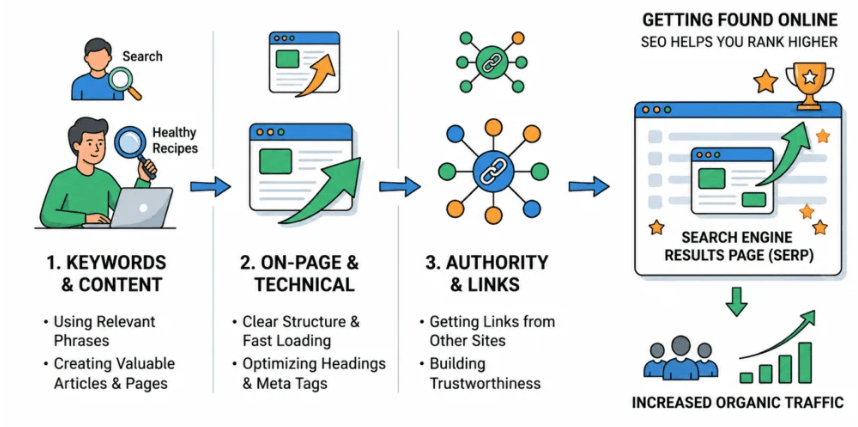
SEO, or search engine optimization, is the practice of improving a website so it ranks higher in search engines like Google for relevant keywords. It covers three main areas: technical setup, on-page content, and off-page signals like backlinks.
Good SEO strategy still forms the base layer for everything else on this list. Without solid technical SEO and quality content, AEO, GEO, and AIO have nothing strong to build on.
Why is SEO Important?
SEO drives free, ongoing traffic without paying for every click. A business that ranks well for its main keywords keeps attracting customers month after month, long after the content was published.
It also builds trust. Users tend to trust organic results more than ads, and ranking high signals to visitors that Google already vetted your site as relevant and reliable.
How to Rank Higher?
- Research keywords that match real buyer intent, not just search volume, and organise them by topic clusters
- Write helpful, original content that answers the question fully instead of padding word count
- Fix technical issues like slow page speed, broken links, and poor mobile experience since Core Web Vitals still affect rankings
- Build internal links between related pages to help Google understand your site structure
- Earn backlinks from real, relevant websites instead of buying links from low-quality directories
- Use clear title tags and meta descriptions that include your primary keyword naturally
- Update older content regularly so it stays accurate and doesn’t decay in rankings
2. SXO (Search Experience Optimization)
What is SXO
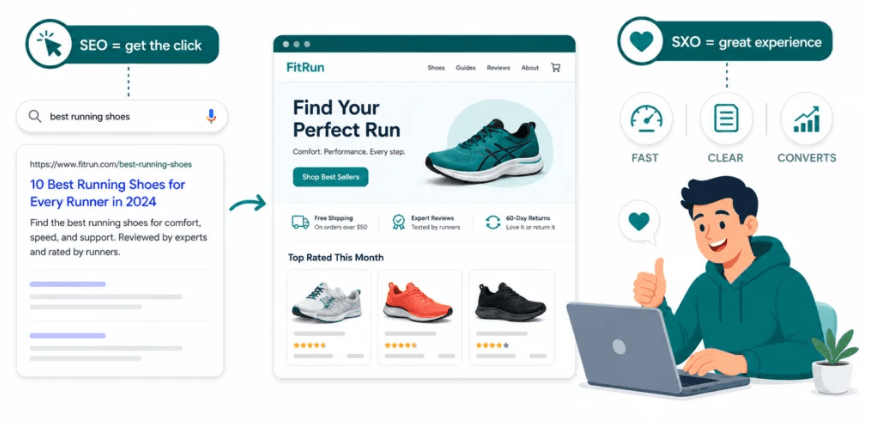
SXO stands for search experience optimization, and it combines SEO with user experience design. It focuses on what happens after someone clicks your link, not just on getting them there.
The goal is simple. Get people to find what they need quickly, enjoy the page, and take action, whether that’s buying a product or filling out a form.
Why is SXO Important
Google already tracks how users behave after they land on a page, including bounce rate and time on site, and factors this into rankings. A page that ranks well but frustrates visitors will lose both rankings and sales over time.
SXO strategy also protects revenue directly. You can rank number one for your target keyword and still make no money if your site is slow, confusing, or hard to use on mobile.
How is SXO Different Than SEO
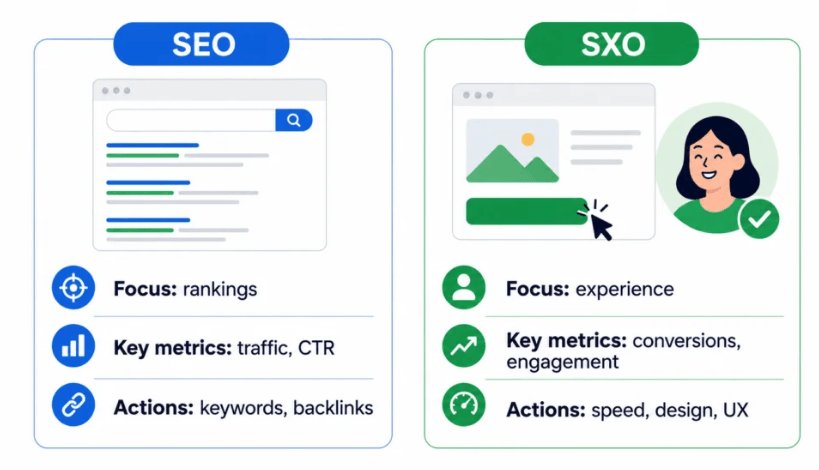
SEO focuses mainly on visibility, getting your page in front of the right searcher. SXO cares equally about what happens next: does the visitor stay, understand the content, and convert?
| Factor | SEO | SXO |
|---|---|---|
| Main focus | Search engine rankings | User experience plus rankings |
| Key metrics | Rankings, traffic, CTR | Conversions, engagement, satisfaction |
| Core actions | Keywords, backlinks, site structure | Fast loading, intuitive design, relevant content |
| Success measure | Organic visits | Visits that turn into customers |
How to Rank Higher
- Improve page load speed to under 3 seconds since slower sites lose visitors fast
- Design a responsive layout that works cleanly across mobile, tablet, and desktop
- Simplify navigation menus so users find answers within a couple of clicks
- Structure content with short paragraphs, subheadings, and bullet points for easy scanning
- Add clear calls to action that guide visitors toward the next step
- Run A/B tests on layout, headlines, and buttons to see what actually improves conversions
- Track bounce rate and session duration regularly and fix pages that underperform
AEO (Answer Engine Optimization)
What is AEO
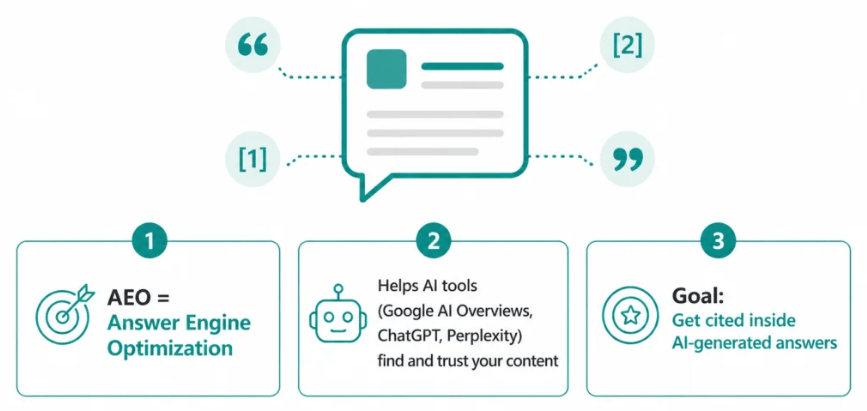
AEO, or answer engine optimization, is the practice of structuring content so AI-driven answer engines like Google AI Overviews, ChatGPT, and Perplexity can find, trust, and quote your information directly. Instead of optimising purely for a ranking position, you optimise to become the source that gets cited inside an AI-generated answer.
This matters because many searches today end without a click, since the AI Overview already gave the user their answer on the results page.
Why is AEO Important
AI Overviews now appear on a large share of Google searches, and organic click-through rates on those queries have dropped sharply, in some studies by around 61 percent. Being cited inside these AI answers still builds brand authority and trust, even without a click, because the user sees your brand named as the source at the exact moment they need an answer.gezar+2
Brands that ignore AEO risk becoming invisible on the exact queries that used to send them the most traffic. Informational queries such as “what is” and “how to” are hit hardest by this shift.
How is AEO Different Than SEO
SEO measures success by ranking position and clicks. AEO measures success by citation frequency inside AI-generated answers, sometimes called “share of model”.
Traditional SEO writes for search engine crawlers scanning full pages. AEO writes short, direct answer blocks near the top of each section so AI systems can lift and quote them easily.
How to Rank Higher
- Answer the core question in 40 to 60 words right at the start of each section, before adding detail
- Use question-based headings that match how people actually ask AI tools, not vague labels
- Add FAQ, HowTo, and Article schema markup so AI systems can read your content as structured data
- Include original data, statistics, and specific numbers since AI models prefer traceable, verifiable facts
- Get your brand mentioned on Reddit, industry forums, and news sites, since AI checks for consensus beyond your own website
- Keep content fresh with regular updates, since AEO strategy rewards recency and accuracy
- Write in a natural, conversational tone that mirrors how users phrase voice and chat queries
GEO (Generative Engine Optimization)
What is GEO
GEO, or generative engine optimization, is the practice of shaping your content so generative AI tools like ChatGPT, Gemini, and Perplexity can understand, trust, and cite it when generating a response. It’s closely related to AEO but goes further, focusing on how large language models retrieve and synthesise information from across the web, not just from a single page.
Where AEO often targets a specific search engine’s answer box, GEO covers the full ecosystem of AI chat tools people now use as their default research assistant.
Why is GEO Important?
Generative AI tools are becoming a genuine alternative to typing a query into Google, especially for research-heavy or comparison questions. If your content isn’t structured for large language models to pull from, competitors who did the work will get named instead, even if your site ranks higher on Google.
GEO strategy also protects long-term relevance as more people use AI assistants as their first stop for information. Businesses that build a strong entity presence now will compound that advantage as AI search adoption keeps growing.
How is GEO Different Than SEO?
SEO optimises for search engine crawlers and ranking algorithms tied to one platform, mainly Google. GEO optimises for how multiple large language models retrieve, interpret, and synthesise information from many sources at once, often called retrieval-augmented generation.
SEO success is a ranking position. GEO success is being one of the sources an AI model chooses to reference when it builds its answer, regardless of ranking.
How to Rank Higher?
- Build topical authority by covering a subject completely across multiple linked pages, not just one shallow post
- Use clear, factual statements that are easy for a language model to extract without ambiguity
- Add author bios and credentials so AI models can verify expertise behind the content
- Structure data in tables, lists, and comparison formats, since these are easier for models to parse and reuse
- Publish original research, surveys, or case studies that don’t already exist elsewhere online
- Maintain consistent brand information (name, description, offerings) across your site and third-party listings
- Monitor how often AI tools reference your brand and adjust content gaps you find
AIO (AI Optimization)
What is AIO?
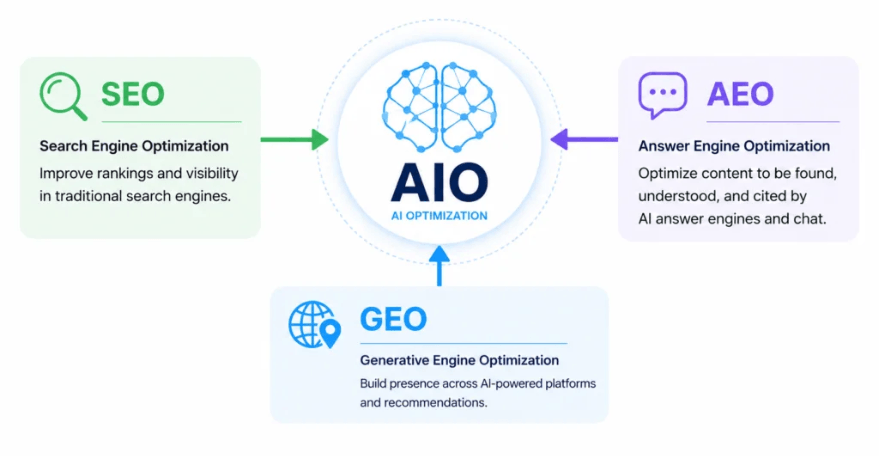
AIO, or AI optimization, is the broader practice of making sure your brand, content, and data are structured for AI-driven discovery everywhere, not just inside one chatbot or search box. It brings together technical SEO, content strategy, and data strategy into one system built for an AI-first environment.
Think of AIO as the umbrella that ties SEO, AEO, and GEO together into a single AI visibility strategy across chatbots, recommendation engines, and social algorithms.
Why is AIO Important?
AI-generated summaries increasingly decide which brands are worth citing before a user ever sees a traditional list of links. Marketing leaders who ignore AIO strategy risk losing visibility across every channel where AI now filters information, including ads, search, and social feeds.
AIO also affects advertising costs. Platforms with strong AI decision-making need clean, well-structured content and first-party data to understand your audience, and without that, campaigns cost more to run for the same results.
How is AIO Different Than SEO?
SEO targets one platform, Google’s search algorithm, and one outcome, a ranking position. AIO spans every AI-mediated surface where discovery happens, including search engines, chat assistants, and recommendation systems.
SEO is a subset of AIO. AIO strategy treats your content, data, and user experience as one connected system that AI models across the internet can recognise, trust, and surface.
How to Rank Higher?
- Unify your content, structured data, and brand messaging so they say the same thing everywhere online
- Invest in first-party data collection to strengthen the signals AI platforms use to understand your audience
- Make sure your product, pricing, and service pages use structured markup that AI systems can read directly
- Build a consistent brand presence across review sites, forums, and social platforms, not just your own domain
- Create content that works for both machines and humans, avoiding either pure keyword stuffing or vague fluff
- Track brand mentions and sentiment across AI platforms, not only Google Analytics traffic numbers
- Align your website, ads, and content teams around one AI visibility goal instead of working in separate silos
SEO Vs AEO Vs GEO Vs AIO Vs SXO: Comparison
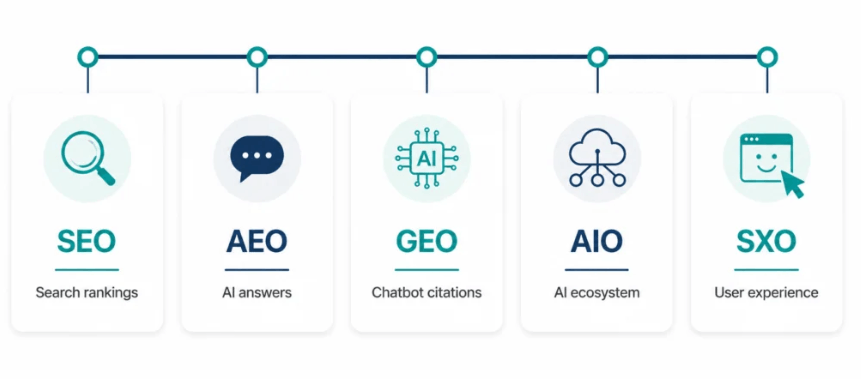
The table below shows how each pillar fits into a complete search and AI visibility strategy for 2026.
| Pillar | Primary Goal | Where It Applies | Key Success Metric |
| SEO | Rank higher in search results | Google, Bing organic search | Rankings, organic traffic |
| SXO | Improve user experience after the click | Your website, landing pages | Conversions, bounce rate |
| AEO | Get cited in AI-generated answers | AI Overviews, chat assistants | Citation frequency |
| GEO | Get referenced by generative AI models | ChatGPT, Gemini, Perplexity | Share of model, mentions |
| AIO | Unify visibility across all AI surfaces | Search, chat, social, ads | Brand presence, sentiment |
These five separate strategies compete for budget. They work as layers stacked on top of each other, starting with solid SEO fundamentals and building outward into experience, answers, generative visibility, and full AI optimization.
Build a Search Strategy with Khalid Hussain That Works
Ranking well in 2026 means showing up wherever people search, whether that’s a Google results page, an AI Overview, or a chat with an AI assistant. A strategy that only chases keywords misses the traffic now flowing through AEO, GEO, and AIO channels, while ignoring SXO leaves conversions on the table even when visibility is strong.
At SEO Visibility, Khalid Hussain has spent over 15 years helping more than 999 businesses, agencies, and eCommerce stores grow through practical, results-driven SEO strategy.


![How Much Does an SEO Expert Cost in 2026 [SEO Pricing]](https://seovisibility.co/wp-content/uploads/2026/01/how-much-does-an-seo-expert-cost.png)
![SEO Copywriting Checklist [Easy to Follow Guidelines]](https://seovisibility.co/wp-content/uploads/2026/01/seo-copywriting-checklist.png)