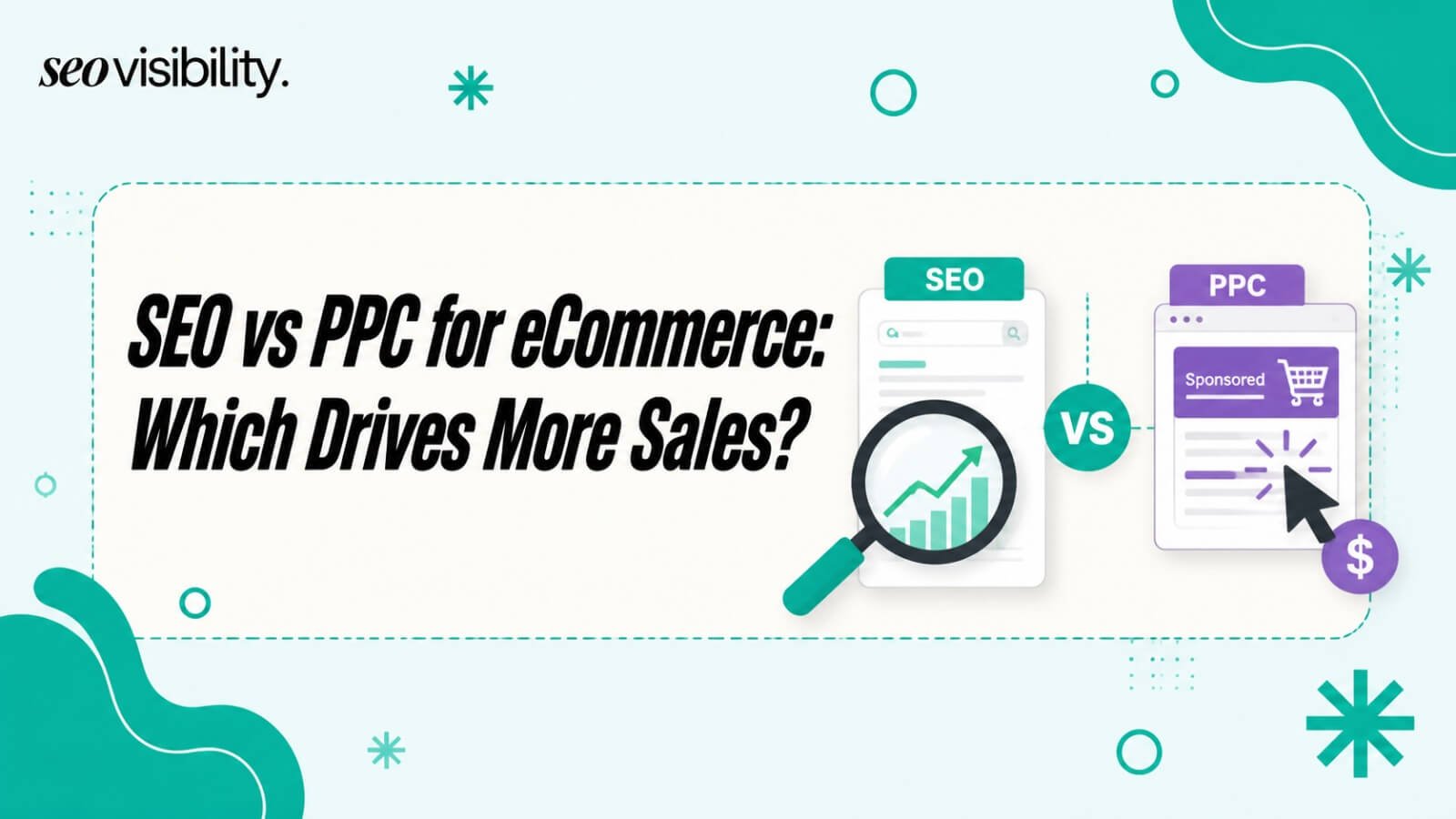
You started heavily investing in your eCommerce store. Every dollar you spend on marketing needs to count.
So when you’re sitting there trying to decide between SEO and PPC (Google Ads), it’s not a casual question — it’s a decision that can make or break your growth this year.
SEO wins for long-term sales growth. PPC wins for immediate, targeted results. And the smartest eCommerce stores use both — strategically.
But that oversimplification won’t help you make a real decision. You need to know why, when, and how each channel works for an online store — especially if your budget has limits.
Let’s break it all down.
SEO and PPC (Pay-Per-Click / Google Ads) Overview
Before diving into the numbers and strategy, it helps to be clear on what each channel does.
SEO (Search Engine Optimization) is the process of optimizing your online store so it ranks higher in Google’s organic (unpaid) search results.
When someone searches “best running shoes for flat feet” and clicks your product page without you paying Google a single cent — that’s SEO working.
PPC (Pay-Per-Click / Google Ads) means you pay Google to show your store at the top of search results. You set a budget, bid on keywords, and pay every time someone clicks your ad.
The moment you stop paying, the traffic stops.
Both channels show up on the same Google results page. But they work very differently, cost differently, and deliver results on completely different timelines.
The Real Cost Difference: SEO and PPC
This is where most e-commerce owners make the biggest mistake — they compare the upfront costs without thinking about the total cost over time.
SEO Costs
SEO isn’t free, but it’s not pay-to-play either. Your investment goes into content creation, technical optimization, link building, and ongoing maintenance. You’re building an asset.
Once your product pages and category pages rank, they keep pulling in traffic month after month — without an ongoing per-click fee.
The math gets interesting when you look at it over time. Suppose you’re spending on SEO for a full year. By month 6, early wins from technical fixes and content start showing up.
By month 12, compounding authority and content drive real traffic. By month 18, organic search often becomes the top revenue source for most e-commerce sites.
Here’s the actual ROI breakdown based on data from 80 eCommerce clients:
| Time Frame | Average SEO ROI | What’s Happening |
|---|---|---|
| 6 Months | 0.8x | Technical SEO gains + early content wins |
| 12 Months | 2.6x | Content and authority start compounding |
| 18 Months | 3.8x | Organic becomes the top revenue channel |
| 24 Months | 4.6x | ROI levels off as content matures |
| 36 Months+ | 5.2x | SEO becomes a low-cost growth engine |
That 5.2x ROI at 36 months is hard to argue with. And the cost per click? Effectively zero once you’ve ranked.
PPC (Google Ads) Costs
Google Ads for eCommerce runs at an average CPC of around $1.16 for search ads, which is actually one of the lowest CPCs across all industries. Google Shopping ads cost even less, averaging around $0.66 per click.
But here’s the catch: those clicks add up fast. If you want 1,000 visitors a month from Google Ads, you’re spending roughly $1,160 every single month. Stop spending, and those 1,000 visitors disappear the next day.
The average Google Ads ROI for eCommerce sits at around 1.9x — meaning for every $1 you spend, you get back roughly $1.90 in revenue.
Meanwhile, SEO returns roughly $19.90 for every dollar invested over the long run, compared to approximately $4.40 for paid ads.
Search advertising costs have also been increasing year over year for the last five years, with 2025 data confirming this trend is continuing.
That means the longer you wait to build your organic presence, the more expensive PPC becomes.
Speed Vs Sustainability for e-Commerce
This is the heart of the SEO vs PPC debate for e-commerce, and it’s important to be honest about both sides.
PPC: Fast, Controlled, and Expensive Long-Term
If you launch a Google Ads campaign today, you can have traffic hitting your store by tomorrow. That’s not an exaggeration — PPC delivers instant visibility. This makes it the obvious choice when you’re:
- Launching a new product and need immediate traction
- Running a seasonal sale (Black Friday, holiday promotions)
- Testing a new market or audience before committing long-term
- Trying to capture sales while your SEO strategy is still building
The average Google Shopping ROAS (return on ad spend) is 4.6x, meaning every $1 spent generates $4.60 in revenue. That’s not bad at all.
PPC is also incredibly flexible — you can target specific zip codes, age groups, shopping behaviors, and device types. You control exactly who sees your ads and when.
The downside? It’s a pay-to-play game. The traffic is rented, not owned. Increase your budget, and traffic goes up; cut your budget, and it drops immediately.
For e-commerce owners with tight margins, this creates a ceiling on how profitable you can get.
SEO: Slow to Start, but Builds Long-Lasting Growth
SEO takes time. There’s no way around that. A brand-new eCommerce store should expect to wait 3–6 months before seeing meaningful organic traffic, and 12–18 months to see compounding results.
But the traffic you earn through SEO is fundamentally different from paid traffic. Organic search drives 53.3% of all website traffic — making it the single largest traffic source across the web.
And here’s what makes it powerful for eCommerce: organic traffic from SEO often converts 2–3x better than paid traffic when your site infrastructure is well-optimized.
Why does organic convert better? Because users searching organically trust those results more.
They’ve gone past the ads and clicked a result they believe is genuinely relevant to their needs. That trust translates into higher purchase intent.
The other massive advantage for eCommerce? Content compounds. A well-written product guide or category page that ranks today can drive traffic and sales for years — without ongoing spend.
Conversion Rates: Which Channel Actually Sells More?
This is one of the most debated points in the SEO vs PPC conversation, and the answer is more nuanced than most articles admit.
PPC can have higher conversion rates in specific contexts. When ads are highly targeted, sent to well-optimized landing pages, and timed around high purchase intent moments, paid clicks can convert extremely well.
One case study showed PPC converting at 8.9% for a cleaning products company, compared to 1.6% for SEO traffic.
On the other hand, broader data tells a different story. SEO nearly always converts at a higher rate than PPC across most industries.
When you look at e-commerce specifically, the average conversion rate for Google Ads in e-commerce sits around 1.91%. Organic traffic, when backed by a strong SEO infrastructure, can convert 2–3x better than paid.
The real takeaway here: PPC converts well when it’s precise. SEO converts well when your content is aligned with buyer intent. Neither wins universally — context matters.
SEO Vs PPC for eCommerce: A Side-by-Side Comparison
Let’s make this easy to digest. Here’s how the two channels stack up across the metrics that matter most to eCommerce store owners:
| Factor | SEO | PPC (Google Ads) |
|---|---|---|
| Time to Results | 3–18 months | Same day |
| Cost Structure | Upfront investment, low ongoing cost | Pay per click, ongoing spend required |
| Long-Term ROI | Up to 5.2x at 36 months | ~1.9x average |
| Traffic Durability | Continues without ongoing spend | Stops when the budget stops |
| Conversion Rate | Higher with optimized content | Higher with precise targeting |
| Targeting Precision | Broad (keyword + content-based) | Highly precise (demographics, location, behavior) |
| Trust Factor | High — users trust organic results more | Lower — users know it’s an ad |
| Best For | Long-term sustainable growth | Quick wins, launches, seasonal campaigns |
| Budget Requirement | Moderate upfront, scales cheaply | Requires constant spending to maintain traffic |
| Scalability | Scales with content and authority | Scales with budget |
When to Choose SEO for Your eCommerce Store
SEO is the right primary investment if you match these situations:
- Your budget is limited and long-term. If you have a modest monthly marketing budget and can’t sustain high ad spend indefinitely, SEO gives you the best compounding return. The money you invest today keeps working for years.
- You’re in a niche with strong informational intent. If customers research before they buy — comparing products, reading guides, checking reviews — SEO-driven content puts you in front of them at every stage of their journey.
- You want to reduce customer acquisition costs over time. Google Shopping CPCs in competitive categories have risen 15–25% annually since 2020. The longer you rely solely on paid ads, the more expensive each customer becomes. SEO flips this dynamic.
- You’re building a brand, not just chasing transactions. Ranking organically builds authority and trust. When shoppers see your store showing up consistently in search results for relevant queries, that recognition drives repeat purchases — something ads rarely achieve alone.
When to Choose PPC (Google Ads) for Your eCommerce Store
There are specific scenarios where PPC is the smarter move — or at least a necessary one:
- You have just launched your store. New stores have zero domain authority. SEO will take time to kick in. Running Google Shopping ads while you build your SEO foundation keeps sales coming in.
- You have a time-sensitive offer. Black Friday sales, holiday promotions, or limited-time deals can’t wait 12 months for SEO to kick in. PPC gets those offers in front of buyers immediately.
- You’re testing new products or markets. PPC campaigns give you fast, real data on which products resonate, which audiences convert, and which keywords drive purchases. This data is gold for informing your SEO strategy later.
- Your competitors are dominating organic results. In highly competitive categories, organic rankings take even longer to build. PPC can help you compete for visibility while your SEO catches up.
The Combined (SEO + PPC) Strategy Most eCommerce Stores Ignore
Here’s the truth that most comparisons between SEO and PPC skip over: the most effective eCommerce marketing isn’t either/or — it’s both, used strategically.
SEO and PPC together drive an impressive 68% of all trackable website traffic. And when combined intelligently, they make each other more powerful.
Here’s how that works in practice:
- Use PPC data to sharpen your SEO. PPC campaigns reveal which keywords drive actual purchases. Use that data to prioritize your SEO content strategy — you’re no longer guessing which pages to optimize.
- Run PPC while SEO builds momentum. For a new store or a new product line, use ads to generate immediate revenue while your organic rankings develop. This is especially smart when you have a narrow launch window.
- Dominate the search results page. When your store appears in both the paid ads section and the organic results for the same keyword, you’re occupying more real estate. Studies show this dual presence builds brand recognition and increases total click-through rates.
- Retarget organic visitors with ads. Shoppers who found you through SEO but didn’t buy are warm leads. Retargeting them with Google Ads gives you a second shot at the conversion — often at a lower cost per acquisition than cold ad traffic.
- Lower your PPC costs with better SEO. Google’s Quality Score rewards relevant, well-optimized landing pages with lower CPCs. Better SEO on your product and category pages directly reduces what you pay per click.
Your Budget Strategy: A Simple Framework for eCommerce Stores
This is where strategy meets reality. Most e-commerce store owners aren’t working with unlimited budgets. Here’s a practical allocation framework based on where you are:
- Early stage (new store, under 6 months old): Invest more in PPC to generate revenue while building your SEO foundation simultaneously. Focus your SEO investment on technical setup and core product/category pages. Think of PPC as the short-term bridge.
- Growth stage (6–18 months): Shift gradually toward SEO. Your organic rankings should be developing, and you can reduce reliance on paid traffic for keywords where you’re already ranking organically. Use PPC for competitive keywords and seasonal pushes.
- Maturity stage (18+ months): Let SEO carry the bulk of your traffic and lower your cost per acquisition over time. Use PPC selectively for high-margin products, new launches, and retargeting. This is where SEO’s compounding advantage really shines.
Common Myths about SEO and PPC for eCommerce
- “SEO is free.”It isn’t. SEO requires investment in content, technical work, and link building. But unlike PPC, you own the results. The returns compound, and the cost per click effectively reaches zero over time.
- “PPC is just for big brands with big budgets.” Not true. eCommerce enjoys some of the lowest CPCs across all industries at just $1.16 average. Even small stores can run profitable Google Shopping campaigns with smart targeting and well-optimized product feeds.
- “Once you rank, SEO takes care of itself.” Rankings require maintenance. Algorithm updates, new competitors, and evolving search intent mean you need to keep investing — just at a lower ongoing rate than building from scratch.
- “PPC and SEO compete with each other.” They don’t. Running both doesn’t split your traffic or hurt your organic rankings. In fact, they actively support each other when coordinated well.
SEO Vs PPC: Which Drives More Sales for eCommerce?
If you could only pick one and had to think long-term, SEO drives more total sales value for eCommerce. The ROI is higher, the cost per acquisition drops over time, and the traffic is durable.
A store that invests consistently in SEO for 24–36 months builds a revenue engine that competitors on pure PPC simply can’t match on a per-dollar basis.
But “long-term” is the key phrase. If you need sales now, SEO alone won’t cut it. PPC fills that gap with precision and speed that no other channel matches.
The stores winning in competitive eCommerce markets aren’t choosing between SEO and PPC. They’re using PPC to win today while their SEO builds the foundation for sustainable growth tomorrow.
That’s not a compromise — it’s a strategy.
Ready to Build an eCommerce Strategy That Actually Grows Sales?
Choosing between seo vs ppc for e-commerce doesn’t have to be a guessing game.
The right answer depends on your specific store, your competition, your budget, and your timeline — and getting it wrong means wasted money and missed revenue.
At SEO Visibility, Khalid Hussain is a freelance eCommerce SEO expert and top-rated SEO partner with 15+ years of experience who has helped 999+ businesses, agencies, and e-commerce stores grow online.
Whether you need a clear SEO roadmap, a smarter approach to seo and ppc for eCommerce, or a complete audit of why your store isn’t showing up in search — Khalid has the experience to show you exactly what to do next.


![How Much Does an SEO Expert Cost in 2026 [SEO Pricing]](https://seovisibility.co/wp-content/uploads/2026/01/how-much-does-an-seo-expert-cost.png)
![SEO Copywriting Checklist [Easy to Follow Guidelines]](https://seovisibility.co/wp-content/uploads/2026/01/seo-copywriting-checklist.png)