Yes, Google reviews really do improve your SEO ranking. Google confirms that review count and review score are part of its local ranking algorithm, and multiple independent studies show reviews account for roughly 17 to 25 percent of local pack ranking factors, making them one of the strongest signals after your Google Business Profile and proximity to the searcher.
If you run a local business, you have probably heard people argue both sides. Some marketers say reviews barely matter. Others treat them like the golden ticket to ranking number one on Google Maps. The truth sits closer to the second camp, but with more nuance than most blog posts admit.
This guide breaks down exactly how Google reviews affect SEO rankings, which review signals carry weight, and what you should do this month to start climbing the local pack.
Why Google Reviews Matter in SEO Ranking
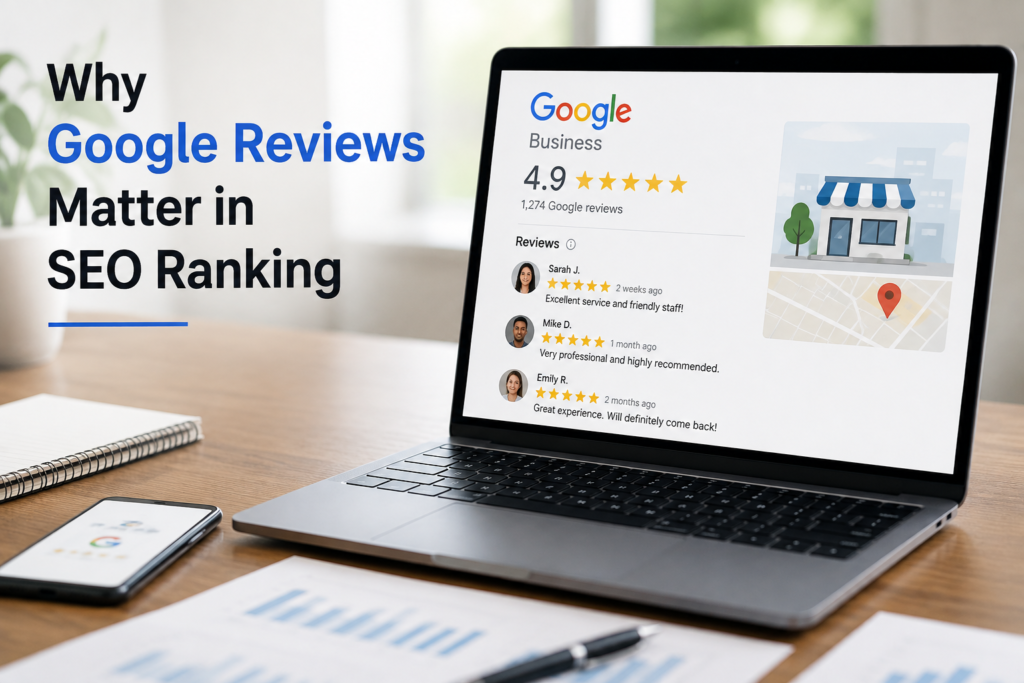
Google’s local ranking system runs on three pillars: relevance, distance, and prominence. Reviews live inside the prominence pillar, which measures how well known and trusted your business appears to be, both online and offline.
Google has stated directly that “high-quality, positive reviews from your customers can improve your business visibility.” That single line from Google’s own help documentation is about as close to an official confirmation as you will get for any specific local ranking factor.
Think about it from Google’s perspective. The company wants to send searchers to businesses that other real customers have vouched for, not just the business with the most polished website. Reviews act as a trust layer that website copy alone cannot replicate, which is exactly why Google reviews and seo rankings are so closely tied together in local search.
Do Google Reviews Help SEO?
If you are asking, “Do Google Reviews help SEO?”, the answer is yes, especially for local SEO.
Google explains that local results are mainly based on relevance, distance, and prominence. Under prominence, Google specifically states that the number of reviews and positive ratings can help a business improve its local ranking.
This means Google reviews and SEO rankings are connected. A business with a healthy stream of real customer feedback, a competitive rating, and helpful owner responses has a stronger chance of standing out in local search than a similar business with little or no review activity.
However, this does not mean that every business with the most reviews automatically ranks first. A nearby competitor with fewer reviews may still appear above you if it is closer to the searcher or better matches the service they searched for.
For example, imagine two plumbers in Dallas:
- Plumber A has 350 reviews and a 4.8-star rating but is 18 miles from the person searching.
- Plumber B has 85 reviews and a 4.6-star rating but is only 2 miles away and has a fully optimized Google Business Profile.
For a “plumber near me” search, Plumber B may rank higher because distance matters. But for a broader search such as “best emergency plumber in Dallas,” Plumber A’s higher prominence and stronger review profile may give it an advantage.
How Google Reviews Help SEO Rankings
Google reviews help SEO rankings mainly by strengthening your local business prominence. Prominence is Google’s way of measuring how well known, trusted, and established a business appears online and offline.
A review profile sends several useful signals at once. It shows that real customers use your business, people are willing to share their experiences, and your company is active enough to receive ongoing feedback.
Here is how Google reviews for local SEO can support your visibility.
Review Quantity
Review volume is consistently cited as one of the strongest individual review signals. Businesses with 100 or more reviews have been shown to rank meaningfully higher in local pack results than businesses with fewer than 20.dworks.
There is no universal magic number here. What matters is having noticeably more reviews than the businesses currently ranking above you in your specific market and category.
Review Velocity and Recency
Recency might be the most underrated ranking signal in the entire review equation. A business earning 50 reviews in the past month typically ranks better than a competitor who collected 200 reviews two years ago and has gone quiet since.
Google appears to reward a steady, ongoing stream of new reviews over a large static pile of old ones. Several sources point to a target of roughly 3 to 5 new reviews per month as the threshold associated with consistently ranking in the top 3 map pack positions.
Star Rating
A high average rating matters, but perhaps not in the way most business owners assume. Research suggests a 4.0-star average is close to the practical minimum for competing in the top 3 map pack, and ratings below that threshold can actively suppress visibility.
That said, going from 4.0 to a flawless 5.0 does not guarantee a jump to the top spot. Semrush’s data found that for the top three positions specifically, rating alone did not correlate strongly with ranking, while review count did. In plain terms, a well-reviewed business with a strong 4.3 to 4.7 average and a large, active review count often outranks a business sitting at a perfect 5.0 with very few total reviews.
Keywords Inside Review Text
When customers mention specific services, products, or locations in their written reviews, that language reinforces relevance for those exact search terms. Whitespark’s survey ranked keyword-rich review content among the top three most influential review characteristics for map pack ranking.
If a customer writes “best emergency plumber in Austin, fixed our burst pipe fast,” that sentence naturally reinforces your relevance for plumbing searches in that city. You cannot script this, but you can gently encourage detailed feedback when you ask for reviews.
Owner Responses to Reviews
This one causes the most confusion, so it deserves a direct answer. Responding to reviews does not appear to be a standalone ranking lever that pushes you up the map pack by itself.
Google does recommend responding, and it counts as a broader engagement signal that supports prominence and improves conversion once someone lands on your profile. But replies do not add a new review, do not change your star average, and do not refresh your recency signal, so treat responding as reputation management and customer service, not as your primary ranking strategy.
Whitespark’s data still places owner responses among the meaningful secondary factors for Google Business Profile conversions, even if the direct ranking impact is smaller than volume or recency.
Google Reviews as a Local SEO Ranking Factor
Google reviews are a real Google reviews ranking factor, but they are one part of a larger local search system. You should understand where they fit before investing all your time into review collection.
| Local ranking signal | What it means | How reviews contribute | What you should do |
|---|---|---|---|
| Relevance | How closely your Business Profile matches a search | Reviews may naturally reinforce services and customer experiences | Use accurate categories, services, descriptions, products, and local website content |
| Distance | How close your business is to the searcher or searched location | Reviews cannot overcome distance in every search | Use accurate address and service area settings |
| Prominence | How well known and trusted your business appears | Review count and positive ratings can support prominence | Earn genuine reviews consistently and respond professionally |
| Website authority | The strength and usefulness of your website | Reviews can improve trust and clicks, but website SEO still matters | Build useful location and service pages, earn local links, and improve technical SEO |
| Profile completeness | Whether your Business Profile is accurate and helpful | A strong review profile works better with a complete listing | Keep hours, phone number, categories, photos, and services updated |
How Google Reviews Impact Local Search Rankings Beyond the Map Pack
Reviews do more than affect where you sit in the Local Pack. They also shape how often people click on your listing once they see it.
Higher star ratings and larger review counts increase click-through rate from map results, and that increased engagement feeds back into Google’s relevance and prominence signals over time.
In other words, reviews create a compounding loop. Better reviews earn more clicks, more clicks reinforce visibility, and stronger visibility earns even more customers who leave more reviews.
There is also a newer angle worth understanding as AI-driven search grows. BrightLocal’s latest local ranking factors research found that reviews are now the second most important factor for both traditional Local Pack rankings and AI-powered local search results, meaning this signal is not fading as search evolves. It is becoming more important.
Which Google Review Signals Matter Most?
Local business owners often want to know exactly which review factors deserve their attention. The most useful answer is not to obsess over one metric.
Build a review program that improves the full customer experience.
Review Count
More reviews can help build prominence, provided the reviews are genuine. Google explicitly says review count is part of local ranking considerations.
Look at the top-ranking businesses in your city and category. If the Local Pack leaders have 300 to 600 reviews and you have 18, your profile likely needs more social proof to compete.
Do not use fake reviews, review farms, or paid review packages. Google prohibits fake engagement, including reviews that do not represent a genuine experience and reviews posted in exchange for incentives.
Average Rating
A high rating helps your business look credible in Maps results. It can also affect whether people click, call, visit, or request directions.
Aim to deliver a service experience that earns strong ratings naturally. If your average rating is low, do not try to hide it by buying positive reviews or blocking unhappy customers from reviewing.
Instead, identify the patterns in negative feedback. Common issues may include long wait times, unclear pricing, missed follow-ups, poor communication, billing problems, or service quality gaps.
Review Recency
Recent reviews make your business profile look active. They also help prospects understand whether your service quality is still consistent.
Create a process that asks every eligible customer for an honest review shortly after the service is completed. The timing should feel natural, such as after a successful appointment, completed repair, delivered product, or closed support request.
Review Detail
Detailed reviews are more persuasive than star-only ratings because they explain why a customer was satisfied or disappointed. They help prospects see whether your business solves problems like theirs.
You cannot control what customers write. But you can create a better experience that gives people something specific and positive to talk about.
For example, a restaurant may earn detailed feedback by providing quick service, clean seating, accurate orders, and friendly staff. A law firm may receive meaningful reviews by communicating clearly, explaining legal steps in plain language, and following up on time.
Common Mistakes That Hurt Your Google Reviews and SEO Rankings
Business owners often approach reviews the wrong way, and it costs them visibility. Here are the mistakes that show up most often.
Buying Reviews
Paid reviews may create a temporary increase in numbers, but they put your profile and reputation at risk. Google does not allow content that does not represent a genuine customer experience.
Fake reviews often have repetitive language, unusual timing, incomplete profiles, or patterns that do not match genuine customer behavior. Customers can also spot them, which can permanently damage trust.
Offering Discounts or Gifts
Do not offer a coupon, gift card, service upgrade, contest entry, loyalty points, or free product in exchange for a review. Google clearly prohibits incentives for posting, revising, or removing reviews.
You can thank customers for their business. You cannot reward them specifically for leaving a review.
Review Gating
Review gating happens when a business filters customers before asking for a Google review. For example, sending happy customers to Google while directing unhappy customers to a private feedback form.
Google prohibits selectively soliciting positive reviews and discouraging negative feedback.
Instead, ask all customers for honest feedback. Use private surveys for service improvement if you want, but do not use them to block dissatisfied customers from publicly reviewing your business.
Ignoring Negative Reviews
A negative review is not automatically an SEO disaster. A business with a few critical reviews can still look more believable than a profile with only perfect ratings.
The damage comes when you ignore legitimate complaints, respond defensively, or repeat the same service issue. Treat negative feedback as a customer service signal and use it to improve operations.
A Simple Monthly Review Plan for Local Business Owners
Building review authority is not complicated, but it does require consistency. Use this simple framework every month.
- Ask every satisfied customer for a Google review within 24 hours of service completion, using a direct link to your profile
- Aim for a minimum of 3 to 5 new reviews per month based on the data around ranking
- Respond to every single review, positive or negative, within 24 to 48 hours
- Check the review count and rating of the top 3 businesses ranking above you and use that as your competitive benchmark
- Encourage customers to mention the specific service they received, without scripting their exact words
This process is not glamorous, but it is exactly what the data supports. Review growth compounds slowly, and businesses that treat it as an ongoing habit consistently outperform businesses that treat it as a one-time task.
Build Stronger Local Rankings With a Trusted Review Strategy
Google reviews genuinely improve your seo rankings, but only when you approach them with the right strategy around volume, recency, rating, and consistent engagement. Getting this right takes more than asking a few customers for a five-star rating once and hoping it sticks.


![How Much Does an SEO Expert Cost in 2026 [SEO Pricing]](https://seovisibility.co/wp-content/uploads/2026/01/how-much-does-an-seo-expert-cost.png)