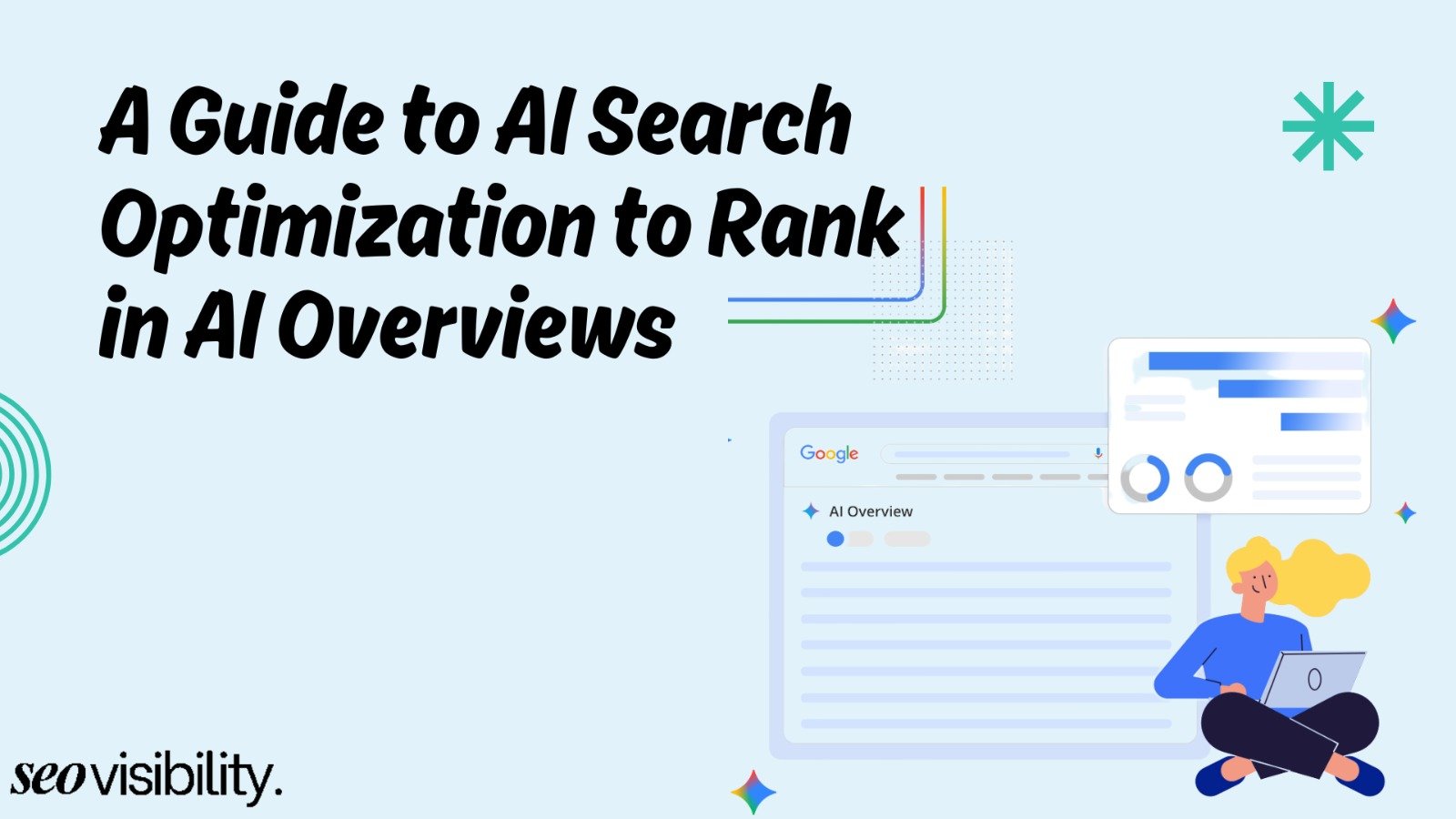
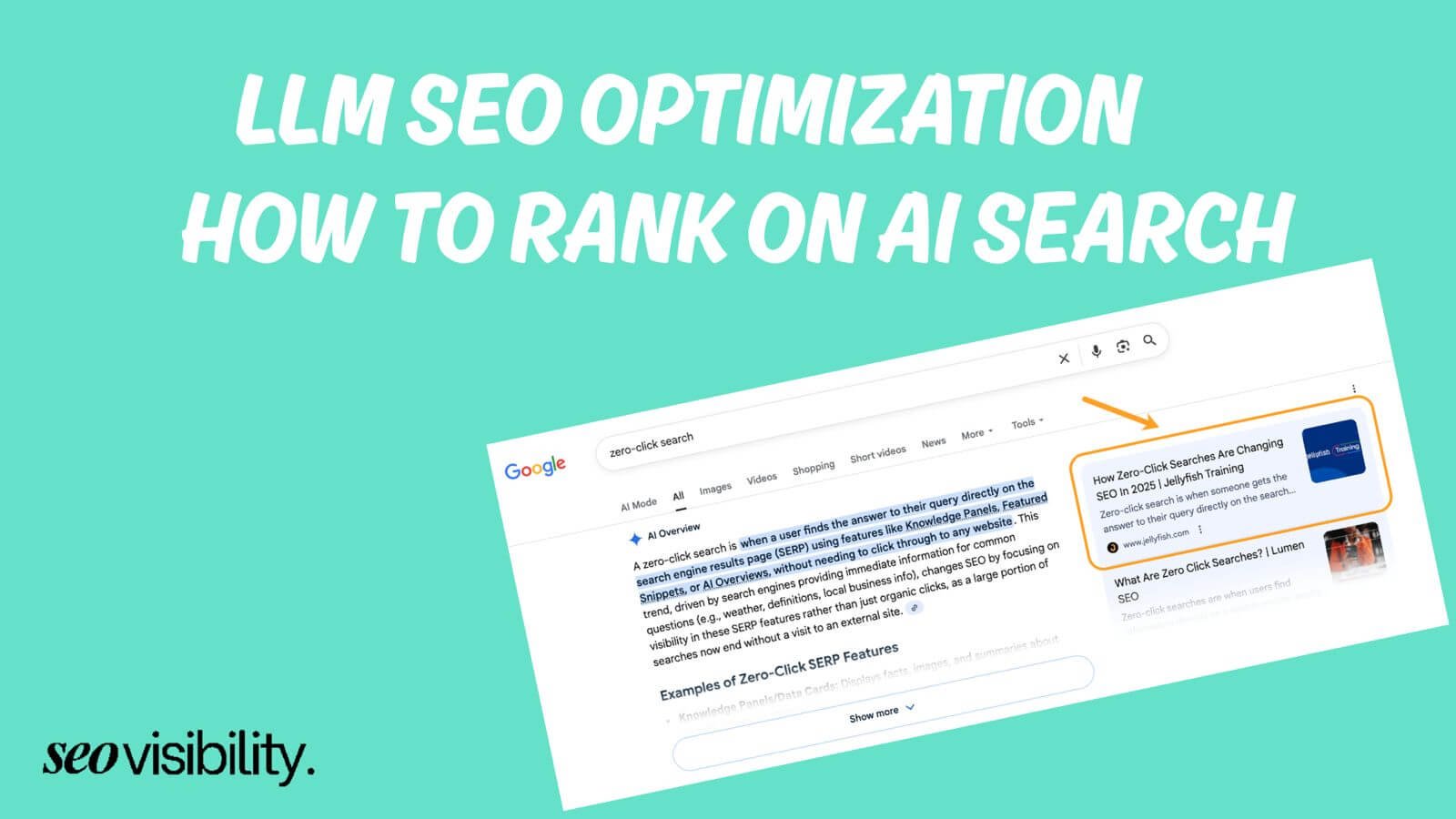
In 2026, over 45% of people use AI tools weekly for research, skipping traditional search entirely. ChatGPT fields over 800 million weekly active users. Google AI Overviews appear on billions of searches every month. Perplexity, Claude, and Gemini are pulling users away from the classic 10 blue links format faster than anyone expected.
Ranking on page one of Google no longer guarantees your brand shows up where it counts. According to this post, The overlap between top Google results and AI-cited sources has dropped from 70% to below 20% as AI systems develop their own preferences for which sources they trust.
So what does this mean for you? It means the rules of visibility have changed. And the businesses that understand LLM SEO optimization right now are building an enormous head start over everyone still playing the old game.
This guide breaks down exactly what LLM SEO is, why it matters, and how to get your content cited by AI search engines in 2026 — with practical, actionable steps you can start today.
What Is LLM SEO Optimization?
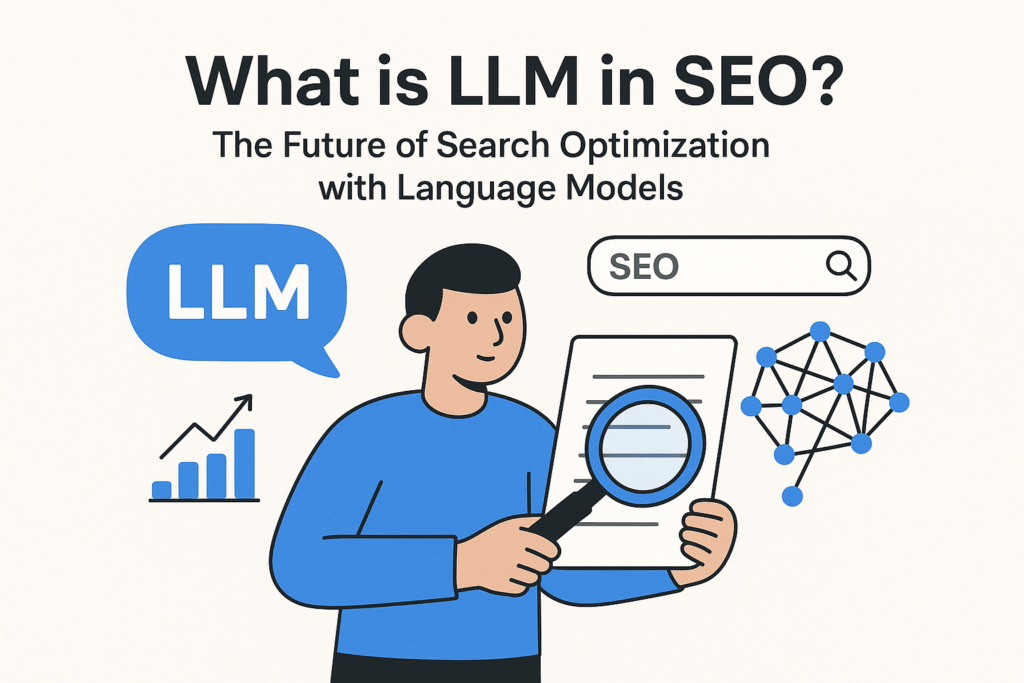
LLM SEO optimization (also called large language model SEO, AI SEO, or generative engine optimization) is the process of structuring your content so that large language models can read it, understand it, and recommend it as a trusted source in AI-generated answers.
Traditional SEO is about ranking on page one so users click through to your site. LLM SEO is different. The goal is to become the source an AI cites when someone asks a question in your niche — even if that user never visits your website directly.
Think of it this way: if traditional SEO is about getting your book onto the library shelf, LLM SEO is about getting librarians to memorize and quote your book whenever someone asks a relevant question.
Brands that get cited by AI enjoy serious advantages. They see 2.3x higher brand recall, earn an 86% trust score compared to 54% for uncited content, and report 40–65% increases in qualified traffic within six months of implementing LLM optimization strategies.
How AI Search Actually Works (And Why It Changes Everything)
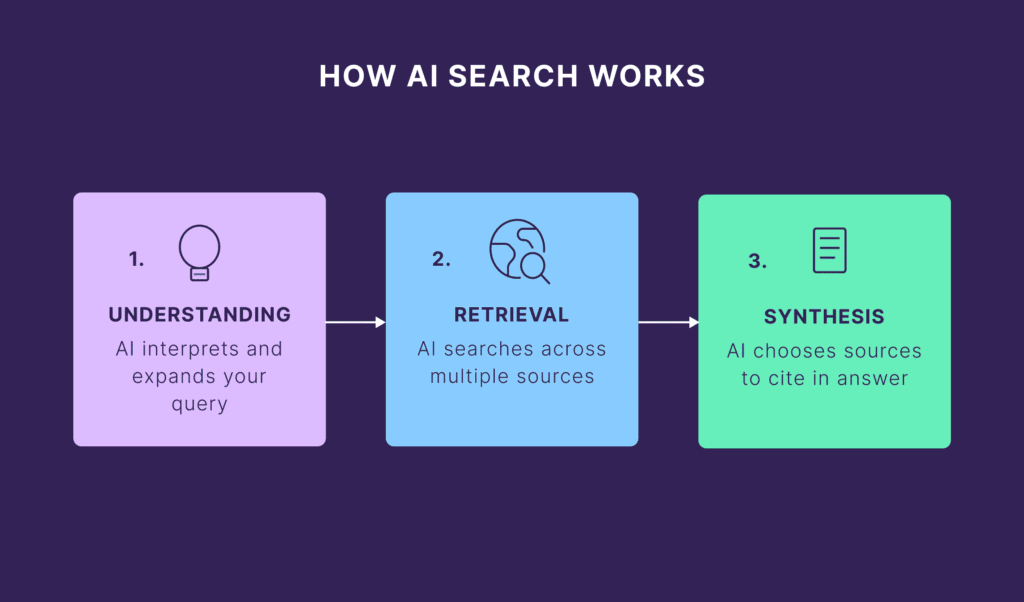
Before you can optimize for AI search, you need to understand how these systems retrieve and surface content. It is very different from how Google works.
When a user types a question into ChatGPT, Perplexity, or Google AI Overviews, several things happen in sequence:
1. Query Fan-Out
The AI does not feed your full question into a search engine. It breaks the question into smaller sub-queries and searches for each one separately. If someone asks, “What’s the best email marketing tool for a small e-commerce store?” the AI might search for “best email marketing platforms 2026,” “email marketing for e-commerce,” and “email marketing pricing small business” as three separate searches.
2. Retrieval-Augmented Generation (RAG)
Most AI search systems use a technique called RAG. They pull specific passages from web pages and feed them to the language model as context. The AI is not pulling entire articles — it is extracting the clearest, most extractable pieces of information.
3. Synthesis and Citation
The AI combines information from multiple sources into one coherent answer. It then cites the most relevant sources. Those citation links drive referral traffic back to the websites they link to — and signal authority to future users.
Understanding this process explains why the content structure, formatting, and clarity you use matter so much more than keyword stuffing ever did.
LLM SEO Vs Traditional SEO Vs GEO: What’s the Difference?
The terminology in this space can be confusing. Here is a clear breakdown:
| Aspect | Traditional SEO | LLM SEO / GEO |
|---|---|---|
| Goal | Rank on page one of Google | Get cited in AI-generated answers |
| Success metric | Rankings, traffic, CTR | Citation frequency, brand mentions, share of AI voice |
| Query type | Short keywords (avg. 4 words) | Conversational questions (avg. 23 words) |
| User behavior | User clicks through to find info | User gets the answer directly |
| Optimization focus | Keywords, backlinks, meta tags | Content structure, entity clarity, and authority signals |
| Key question | “Are we on page one?” | “Are we in the answer?” |
The important thing to know: these are not competing strategies. Strong traditional SEO directly powers LLM visibility, because AI models rely on live web search to find and retrieve sources. If your pages rank well for the sub-queries AI systems search, you get cited. Both work together.
Why LLM SEO Matters More Than Ever in 2026
Here are the numbers that make this urgent:
- ChatGPT has approximately 800 million weekly active users and commands around 64–70% of AI chatbot traffic
- Google Gemini has surged to over 21% market share and integrates directly with billions of Google searches
- Perplexity processes millions of queries daily with a strong focus on explicit source citations
- Apple is integrating AI-native search, including Claude and Perplexity, directly into Safari
Users also interact with AI search differently from traditional search. Sessions average 6 minutes compared to seconds on Google. Queries average 23 words versus 4 on traditional search. And users treat AI answers as authoritative — not as starting points for more research.
Traffic arriving from AI citations also converts differently. It is lower volume but higher intent. Users who arrive via an AI citation have already received a recommendation. They are further along in their decision-making and significantly more likely to convert.
If your content is not showing up in AI answers, you are invisible to a growing segment of your most qualified buyers.
The 3-Layer Framework for LLM Visibility
Before diving into tactics, it helps to have a mental model. Think of LLM SEO as having three foundational layers:
Layer 1 — Technical Accessibility: Can AI crawlers actually read and parse your content? This includes schema markup, crawlability, rendering, and site structure.
Layer 2 — Semantic Clarity: Do AI systems understand what your content is about? This involves clear language, well-defined entities, answer-first formatting, and topical depth.
Layer 3 — Authority Signals: Do AI systems trust your content enough to cite it? This is where E-E-A-T, brand mentions, backlinks, and content freshness come in.
Most websites fail at Layer 1. Fix all three to dominate AI citations in your niche.
How to Rank on AI Search in 2026 (Step-by-Step)
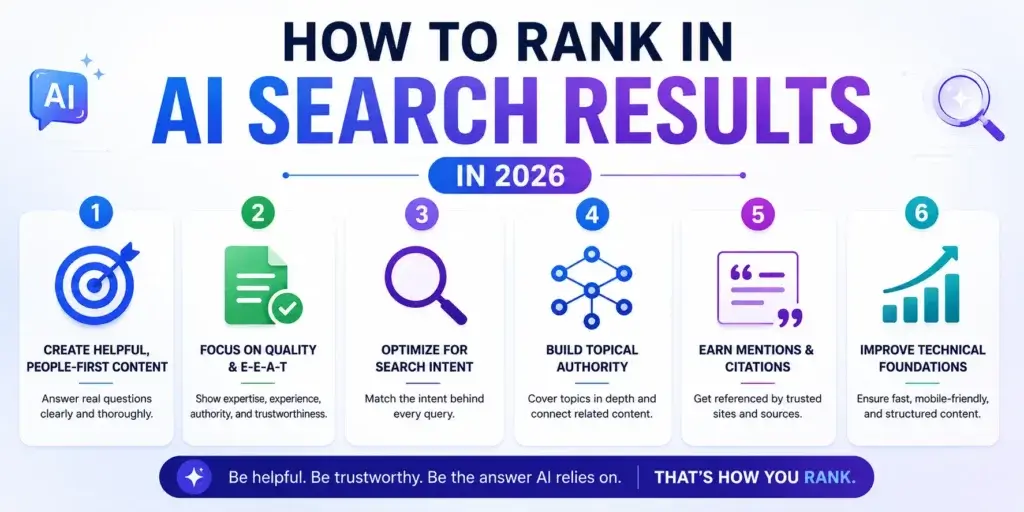
Step 1: Make Sure AI Can Access Your Content
Check your robots.txt file. Many sites unknowingly block AI crawlers. If you use Cloudflare, check your settings — it recently changed its default configuration to block AI bots for many users. Look in your server logs for user agents like “ChatGPT-User,” “PerplexityBot,” and “ClaudeBot” to confirm bots are visiting your pages.
Avoid hiding content behind JavaScript. AI crawlers read the HTML your server returns. Content that loads dynamically after page render — like interactive pricing tables, accordion dropdowns, or tabbed content — is invisible to AI systems. If you want it cited, it needs to live in the raw HTML.
Set up Bing Webmaster Tools. Bing’s index powers multiple AI platforms, including Copilot and many Perplexity queries. Sites properly configured in Bing see AI citations appear 3–4 weeks faster than those relying solely on organic crawling. Submit a clean, structured sitemap and resolve all crawl errors.
Add an llms.txt file. This is a new web standard — a plain-text file placed at your site root that acts as a curated index for AI crawlers, pointing them directly to your most important pages. Adoption has grown from 0.015% to over 2% of top sites in just one year, and it is still an easy win that most competitors have not taken yet.
Step 2: Structure Content for AI Extraction
AI systems do not read your page — they extract from it. The easier you make extraction, the more often you get cited.
Lead with the answer. Put the key information at the top of every section. AI systems are looking for direct, extractable answers. Content using the inverted pyramid structure (answer first) gets cited by LLMs 60% more frequently than content that buries the answer in paragraphs.
Use clear heading hierarchies. Organize content with logical H1, H2, and H3 headings. Each section should cover one distinct topic. AI systems use headings to understand what each section is about and to retrieve specific passages.
Write scannable, chunked content. Pages with structured lists, quotes, and statistics show 30–40% higher visibility in AI responses. Keep paragraphs to two or three sentences. Use bullet points for processes and comparisons. Use tables for comparing options.
Use question-based headings. Frame your H2s and H3s as actual user questions — the kind people ask AI assistants. This directly mirrors how AI systems search for sub-queries and increases your chances of showing up in that extraction layer.
Add FAQ sections. FAQs are one of the highest-performing formats for AI citation. Keep answers in the 40–60-word range for optimal extraction. Place FAQs at the end of major content sections so they summarize the key points AI can lift directly.
Step 3: Implement Schema Markup
Schema markup is not optional in 2026. Pages with comprehensive structured data are cited up to 40% more frequently in LLM responses compared to pages without it.
Schema acts as a translation layer between your content and AI systems. Instead of forcing AI to guess meaning through natural language processing alone, structured data provides explicit signals about what your content represents.
The four schema types that matter most for LLM SEO:
- FAQPage schema — Essential for question-answer content. AI systems parse this directly to extract concise answers that match user queries.
- Article schema — Establishes content type and authorship, reinforcing expertise and credibility signals that AI systems evaluate.
- HowTo schema — Structures step-by-step instructions in a format AI can easily process and cite.
- Organization schema — Helps AI distinguish your brand from competitors and establishes entity recognition in knowledge graphs.
Use JSON-LD for all schema implementations. JSON-LD separates schema from HTML, making it cleaner and more reliable for AI parsing. LLMs can process schema markup up to 10x faster than unstructured HTML.
Step 4: Build Topical Authority
Topical depth is the number one ranking factor for both traditional search and LLM visibility. AI systems view you as an authority when you comprehensively cover an entire topic ecosystem — not just one or two pages.
Do not write one article about your main topic. Build a content cluster. For each area of your business or expertise, create content that covers the full range of related questions users ask. Guides, FAQs, comparison articles, case studies, process walkthroughs, and data-driven pieces all work together to show AI systems you own a topic space.
The more comprehensive your content ecosystem is, the more AI systems recognize you as an authority figure for that subject. This is not about volume for its own sake — it is about demonstrating complete, reliable coverage that users and AI systems can depend on.
Step 5: Strengthen Your E-E-A-T Signals
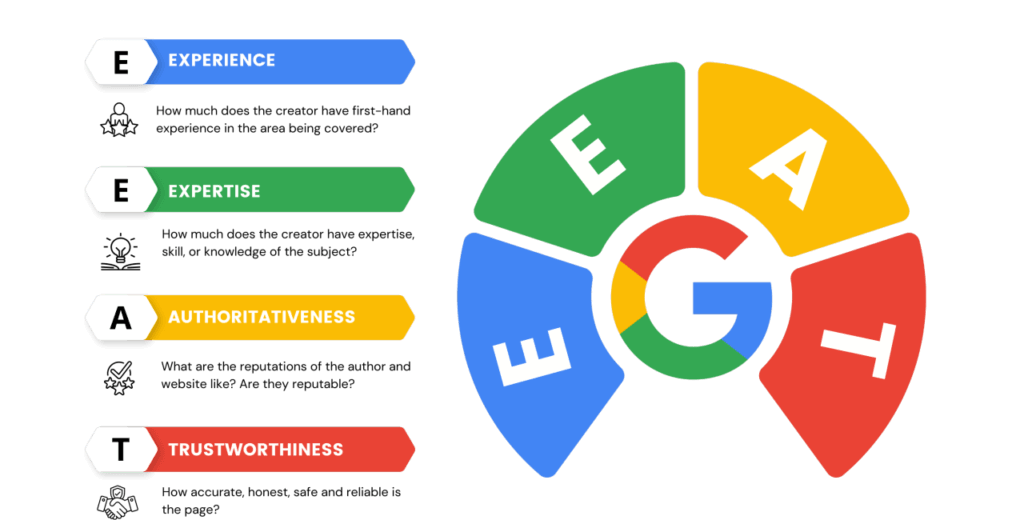
E-E-A-T (Experience, Expertise, Authoritativeness, Trustworthiness) matters more in 2026 than it ever did for traditional SEO. AI writing has flooded the internet with low-quality noise. As a result, AI systems increasingly lean on trusted publishers and real human expertise to reduce hallucinations and deliver reliable answers.
Here is what each pillar means in the LLM era:
Experience: Share first-hand stories, real case studies, behind-the-scenes details, and observations from your own work. AI cannot replicate lived experience, which makes it your biggest competitive advantage. Use language like “when we implemented this” and “here is what we observed.”
Expertise: Add detailed author bios with credentials, professional backgrounds, and track records. Include schema markup for Author and Person to communicate qualifications directly to AI systems.
Authoritativeness: Earn backlinks and citations from recognized industry publications. The more other credible sources reference you, the more LLMs surface your content. Authority compounds over time.
Trustworthiness: Ensure HTTPS, transparent authorship, clearly visible last-updated dates, and links to supporting sources for all major claims. Cite your statistics. Name your sources. AI systems reduce uncertainty by citing publishers they trust, so they signal trustworthiness at every level.
Step 6: Write for the Way AI Retrieves Content
LLMs process content in chunks. Key points buried in long paragraphs get overlooked. Here is how to write for the way AI actually reads:
Use natural, conversational language. AI models are trained on human language and understand conversational tone better than keyword-stuffed text. Write as if you are answering a question someone asked you directly.
Enrich content with entity-rich sentences. Clearly define every important term, brand, person, or concept on first use. Introduce acronyms before abbreviating. Repeat your primary entity in key supporting sentences to help AI systems build accurate knowledge graph associations.
Target the sub-queries AI searches for. Remember the query fan-out process. Think about what shorter keyword phrases an AI might search to answer the bigger question your content addresses. Make sure you have clear, rankable content for each of those sub-queries as well.
Keep content current. AI has a strong recency bias. Pages updated within the last 6 months get cited 2.5x more often than older content, even when the older content holds a higher Google ranking. Update your most important pages every 3–6 months. Add new data, remove outdated examples, and show the revision date clearly in both the visible page and schema markup.
Step 7: Earn Brand Mentions and Citations Across the Web
AI systems learn about your brand from the entire web, not just your own site. This is one area where LLM SEO optimization goes beyond traditional on-page work.
Get mentioned in sources AI already cites. Find out which web pages are already being cited by AI for queries in your niche. Then get your brand referenced in those pages.
Contributing a quote, providing a data point, or reaching out to an author to be included in an existing high-citation article is often the fastest path to AI visibility. Brands have gone from completely invisible to receiving first AI mentions in under an hour using this method.
Unlinked mentions carry weight. AI systems give brand mentions significant weight even without a hyperlink. Casual references to your brand name across the web build AI recognition. Track unlinked mentions and work to convert them into links where possible — but do not ignore them if a link is not available.
Be active on the platforms AI references. Reddit, YouTube, and topical forums appear frequently in AI responses. Authentic participation in relevant communities builds visibility. Spam does not.
Pursue digital PR and original research. Publishing your own data, studies, or unique statistics creates something AI systems want to cite to validate their responses. When your brand owns proprietary data, LLMs have a specific reason to reference you. Campaigns combining original research with digital PR create compounding authority growth across AI-indexed ecosystems.
Get into directories and databases. AI systems pull from trusted databases and review platforms. Listing your brand on sites like G2, Clutch, relevant industry directories, and obtaining a Wikipedia entry (where applicable) puts you in sources AI regularly uses as reference points.
Step 8: Optimize for Each AI Search Platform
Core LLM SEO principles apply everywhere, but understanding platform-specific behavior helps you prioritize:
| Platform | Market Share | Key Characteristic | Optimization Priority |
|---|---|---|---|
| ChatGPT | 65% | Largest reach, conversational depth, web search + training data | Comprehensive content, clear sourcing, E-E-A-T |
| Google AI Overviews | Part of billions of searches | Integrates with Google ranking signals | Strong organic SEO foundation |
| Google Gemini | 21% | Fastest-growing, Google ecosystem integration | Google SEO performance translates directly |
| Perplexity | 2.5% | Citation-focused, real-time web search, highest SaaS conversion | Fresh content, explicit source citations |
| Claude | 2% | Synthesizes rather than quotes directly, Apple Safari integration | Logical structure, well-organized arguments |
Perplexity favors recent content and is more transparent about sources — making it especially important to keep your content fresh and your citations explicit. Google AI Overviews respond well to strong organic SEO performance. ChatGPT rewards comprehensive, well-sourced content with clear expertise signals.
Technical SEO Checklist for LLM Optimization
The technical foundation for LLM SEO shares a lot with traditional technical SEO, but with some new priorities:
- Verify AI crawlers (PerplexityBot, ChatGPT-User, ClaudeBot, GoogleOther) are not blocked in robots.txt
- Check CDN settings — Cloudflare users should confirm AI bot traffic is not being blocked
- Ensure important content is server-side rendered, not hidden in JavaScript
- Confirm no key content sits behind logins, paywalls, or interactive drop-downs
- Create an llms.txt file at your site root, pointing AI crawlers to key pages
- Implement JSON-LD schema (FAQPage, Article, HowTo, Organization, Author)
- Use HTTPS — AI platforms prioritize secure sites for citation trust
- Optimize page speed — sites loading under 2 seconds get crawled 5x more frequently
- Ensure mobile-first design — AI queries increasingly originate from mobile
- Submit a structured sitemap to Bing Webmaster Tools
- Use clean, descriptive URL structures that reflect content topics
- Build a strong internal link architecture to connect topically related content
How to Track and Measure Your LLM SEO Performance
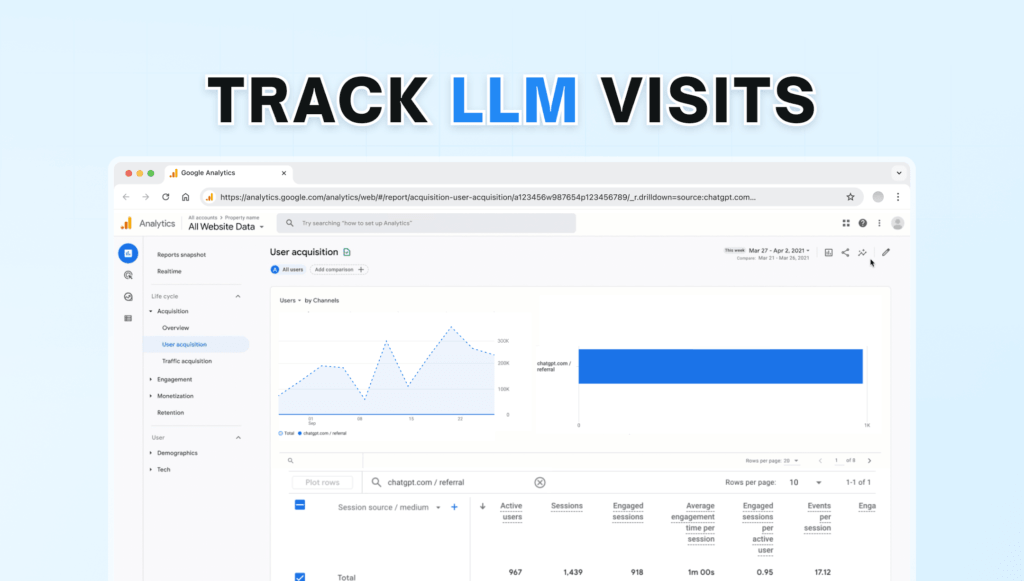
Traditional analytics will not tell you how your content performs in AI search. You need a different measurement approach.
Key metrics to track:
- Citation frequency — How often your pages are referenced in AI answers for your target queries
- Share of AI voice — What percentage of AI responses in your niche include your brand, relative to competitors
- Platform distribution — Which AI platforms cite you most, and where the gaps are
- Query coverage — What percentage of your target queries return your brand in AI responses
- Brand mention accuracy — How accurately AI systems describe your brand and services
How to measure without expensive tools:
Run manual prompt tests monthly. Identify 15–20 queries relevant to your business. Ask them across ChatGPT, Perplexity, and Gemini. Note whether your brand appears, how it is described, and which sources are cited. Track changes over time.
Dedicated LLM SEO tracking tools worth knowing:
Several specialized tools now help monitor AI search visibility: platforms like Profound, Otterly AI, Peec AI, AIclicks, and Keyword.com track brand mentions, citation frequency, and share of AI voice across major LLM platforms. Manual testing across platforms remains one of the most reliable quality checks, regardless of what tools you use.
Common LLM SEO Mistakes to Avoid
Blocking AI crawlers by accident. Many sites discovered after months of poor AI visibility that their robots.txt or CDN was silently blocking AI bots. Check this first.
Hiding content in dynamic elements. Tabs, accordions, and sliders require clicks to reveal content — content that is invisible to AI crawlers. Put the important stuff in plain HTML.
Publishing thin or surface-level content. AI systems want to cite comprehensive sources. A 500-word article covering a topic shallowly will not make the cut when a deeper piece is available.
Ignoring content freshness. When content becomes more than 3 months old, AI citation rates drop off sharply. Publish and update regularly.
Treating GEO and traditional SEO as entirely separate. They reinforce each other. AI models use live web search. Strong SEO performance directly feeds AI visibility.
Relying entirely on AI-generated content. Overuse of AI-generated text lowers your chances of being cited. First-hand experience, real case studies, and original data are what AI systems cannot reproduce elsewhere — and exactly what they want to reference.
Hire an LLM SEO Optimization Expert
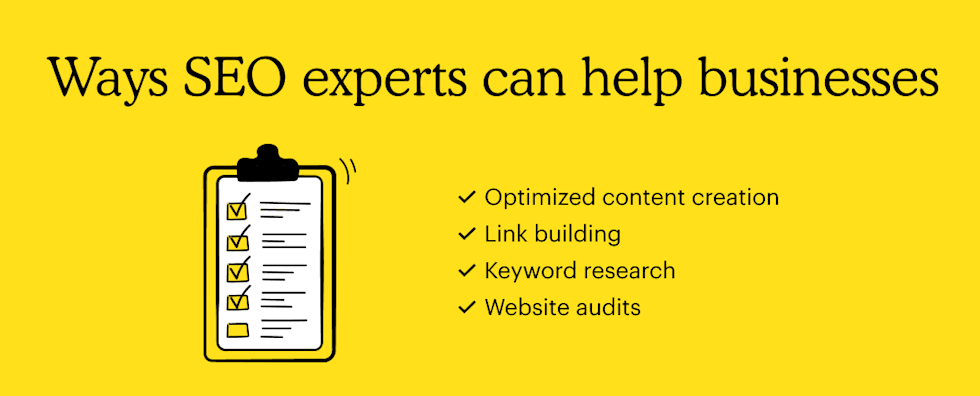
LLM SEO optimization is not a future strategy. It is the strategy for 2026. The businesses that get their content structured, their authority built, and their brand mentioned in the right places right now are capturing visibility that will compound for years.
The path is clear: build technical accessibility, create semantically clear content, demonstrate authority through E-E-A-T and real-world expertise, earn citations from trusted sources, and keep everything current. Do all of that, and AI search engines will cite you with increasing frequency across every platform that matters.


![How Much Does an SEO Expert Cost in 2026 [SEO Pricing]](https://seovisibility.co/wp-content/uploads/2026/01/how-much-does-an-seo-expert-cost.png)