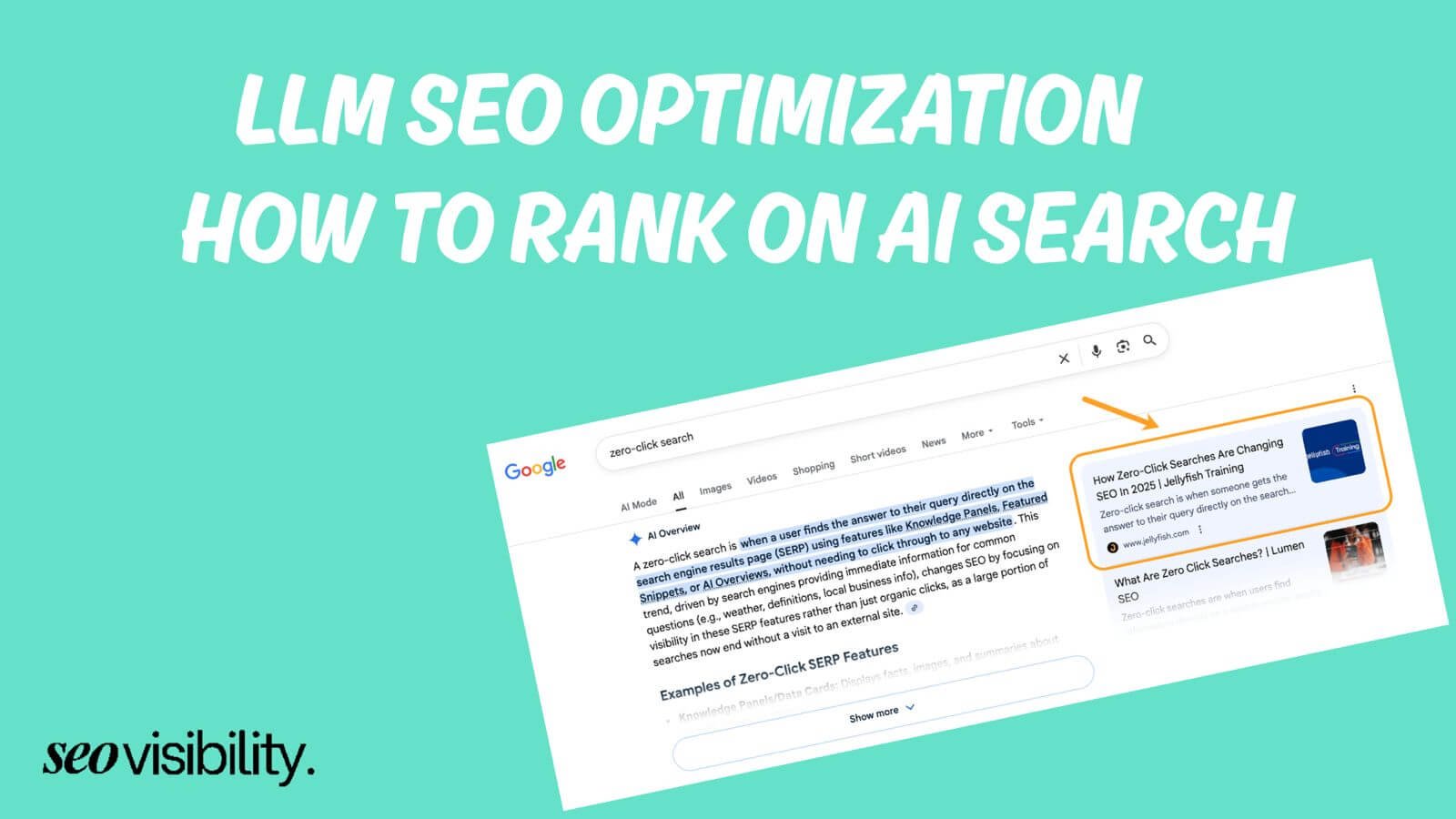
Here is something that should concern every SEO professional right now: users who see an AI-generated summary at the top of search results click on a traditional link only 8% of the time — roughly half the click rate of searches without one. That number is not a bug in the data. It is a signal that the game has changed.
AI-powered search engines like Google AI Overviews, Perplexity, Google Gemini, and ChatGPT are no longer just surfacing links. They are writing the answer themselves — and they are selecting specific sources to cite as they do.
If your content is not one of those sources, you are essentially invisible to a growing portion of your audience, regardless of where you rank in traditional search results.
What “Ranking” Actually Means in AI Search
Traditional SEO was about climbing to position one on a results page. AI SEO is about something different: earning a citation inside the AI’s answer. These are two completely separate things, and confusing them is costing brands visibility.
Consider this: only 14% of URLs cited by Google’s AI Mode rank in the traditional top 10 search results for the same queries. That means roughly 86% of AI citations come from pages that would never have been considered “ranking” under the old model. At the same time, around 59.6% of AI Overview citations come from URLs not even in the top 20 organic results. The leaderboard has been reshuffled, and the criteria that matter are different now.
This shift is what practitioners are calling Generative Engine Optimization (GEO) — the practice of structuring and distributing content so that AI systems trust it enough to cite it. It is not a replacement for traditional SEO; it is an extension of it. Your organic ranking foundation still matters — 76% of AI Overview citations come from domains that rank in Google’s top 10 — but ranking alone is no longer enough. A #1 ranking only gives you a 33.07% probability of appearing in an AI Overview, meaning you can be at the very top of Google and still be ignored by the AI.
The underlying shift is structural. Traditional SEO optimizes pages for algorithms that scan for keywords and count links. AI search optimization works differently — it optimizes individual passages for language models that extract quotable, self-contained facts.
Traditional SEO Vs AI Search Optimization (GEO)
Understanding the difference between the two approaches makes the strategy much clearer. Here is how they compare across the dimensions that matter most:
| Dimension | Traditional SEO | GEO / AI Search Optimization |
|---|---|---|
| Primary trust signal | Backlinks (0.218 correlation) | Brand mentions (0.664 correlation) |
| Content structure | Full-page optimization | 800-token extractable chunks |
| Success metric | Clicks and traffic | Citations and share of voice |
| Query type focus | All queries | Informational queries (88% of AI triggers) |
| Optimization unit | Web page | Individual passages |
| Domain authority role | Strong driver | Declining (r=0.18 correlation) |
| Structured data purpose | Enable rich snippets | Improve concept recognition and factual parsing |
The biggest mindset shift here is the first row. Branded web mentions correlate with AI Overview appearances at 0.664, while backlinks correlate at just 0.218. That is a dramatic inversion of traditional SEO priorities, and it changes where your energy should go.
How LLMs Choose Sources to Cite
AI language models do not randomly pick sources. They use retrieval systems that score content based on several factors, and the patterns in that data are telling.
Semantic completeness is the single strongest ranking factor, with a correlation of r=0.87 in an analysis of over 15,000 AI Overview results. Content that provides a complete, self-contained answer — without requiring the reader to click elsewhere — is 4.2× more likely to be cited than content that only partially addresses the query.
Verifiable facts dramatically raise citation probability. Content with recent statistics, cited data, and cross-referenced claims gets 89% higher selection probability in Google AI Overviews because the system cross-checks facts against authoritative databases in real time. Vague, generic claims get filtered out.
Third-party validation is the most underused lever. Brands with multi-source validation — their claims appearing across five or more external domains — see citation rates improve by 67% in AI overviews.
AI engines are fundamentally more likely to cite a source that other trusted sources have already cited first. In fact, brands are 6.5× more likely to be cited through third-party sources than through their own domain alone.
Different AI platforms also have distinct citation preferences worth knowing:
| Platform | Citation Bias | Best Content Type | Update Frequency |
|---|---|---|---|
| ChatGPT | Wikipedia dominance (47.9% of top citations) | Comprehensive, factual, properly attributed | Real-time via Bing |
| Perplexity | Reddit concentration (46.7% of top citations) | Fresh, community-validated, list format | Hours to days |
| Google AI Overviews | Authoritative indexed sources | Semantically complete, structured data-enabled | Real-time crawl |
| Claude | Technical precision, conservative | In-depth, precise, well-sourced | Training cutoff |
7 Simple Steps to Rank in AI Search and Start Winning AI Citations for Your Brand
Ranking in AI search is no longer just about keywords and backlinks. If you want better visibility in AI-generated answers, you need content that is clear, trustworthy, well-structured, and easy for AI systems to understand.
The seven steps below will help you improve your AI search optimization and increase your chances of earning citations.
- Structure content with clear headings, 120–180 word sections, and answer-first formatting
- Implement FAQPage, HowTo, Article, and Organization schema markup
- Build topic clusters with 10–15 interconnected pages and bidirectional internal linking
- Make E-E-A-T signals machine-readable through author pages, attribution, and original data
- Earn third-party brand mentions across Reddit, review platforms, and industry publications
- Write in natural, conversational language and vary your vocabulary throughout
- Track citations monthly and fill gaps with targeted new content
Step 1: Structure Your Content for AI Search Discovery
The first practical shift is about how you format, structure, and optimize your content for answer engines, not what you say. AI systems do not read a page the way a human does — they extract passages in chunks and evaluate each chunk independently. If your best insights are buried inside long paragraphs, they will not be retrieved.
Write answer-first. Place a concise, direct answer at the top of every page, ideally between 50 and 150 words. This is the section an AI model extracts first when pulling a summary. Everything else — the context, examples, and nuance — follows below. Think of it as the inverted pyramid structure journalists use: lead with the conclusion, then support it.
Use a clear heading hierarchy. An H1→H2→H3 structure tells retrieval systems what a passage is about before they read it. Pages with proper heading hierarchy are 40% more likely to be cited than those with flat or inconsistent heading levels. Each section should be self-explanatory when read in isolation, because that is exactly how AI retrieval works — passage by passage.
Keep section length in a specific range. Pages with 120–180 words between headings receive 70% more citations than pages with sections under 50 words. Short sections lack enough context for reliable extraction; long sections are hard to chunk cleanly. That range is the sweet spot.
Use lists and comparison tables. List-format content has a 50% top-3 citation rate on Perplexity, partly because lists act as structured datasets in human-readable form.
When an AI retrieval system is designed to pull discrete, verifiable facts, a numbered or bulleted list gives it exactly what it needs. Tables with extractable data perform particularly well for ChatGPT and Perplexity.
Make your content machine-readable at the technical level. Use semantic HTML5 elements and ensure your content is readable even with JavaScript disabled. Pages blocked by robots.txt, carrying noindex tags, or relying on JavaScript rendering cannot be retrieved — no matter how good the content inside them is.
Step 2: Implement Schema Markup That Actually Helps
Schema markup is not a magic bullet, but skipping it is leaving citations on the table. Schema-enabled pages have a 47% top-3 citation rate on Perplexity, compared to 28% without it — a statistically significant gap. Pages with robust schema are also 36% more likely to appear in AI-generated summaries overall.
Think of schema as entity mapping. It turns a webpage from an unstructured block of text into a machine-readable graph of facts. The schema types that matter most for AI search optimization are:
- FAQPage schema — maps directly to the question-answer format AI models use when generating responses. Use it on any page that answers distinct questions.
- HowTo schema — structures procedural content step by step, making it easy for AI to extract instructions for action-oriented queries.
- Article schema — signals authorship and content freshness, feeding directly into E-E-A-T evaluation by AI models.
- Organization schema — defines your brand entity with name, URL, logo, description, and sameAs links to social profiles and review platforms. This is how AI systems build a stable representation of your brand.
- Person schema on author pages — connects named authors to verifiable credentials, publication history, and social profiles. Content with proper author metadata gets cited 40% more frequently than anonymous content.
One important note: the structured data is only as good as the content inside it. Generic answers in your FAQ schema are wasted markup. Each schema answer needs named entities and specific, verifiable claims.
Step 3: Build Topical Authority Through Content Clusters
One of the clearest patterns in AI citation data is this: AI systems do not evaluate individual pages in isolation. They treat a content cluster as a unit. Websites with full topic clusters — ten or more interconnected pages on a subject — earn 3.2× more AI citations than sites with isolated articles. Sites filling content gaps within clusters earn 2.4× more citations than brands without comprehensive topic coverage.
The mechanism is straightforward. When you have multiple pages covering a topic from different angles, each linked to a central pillar page and to each other, you are telling AI systems that your site is not just dabbling in a subject — it knows it deeply. Topical breadth does not just get your content retrieved; it helps you rank within the retrieved set.
How to build a topic cluster for AI citation:
- Choose a core topic where you have real expertise or a competitive angle. Pick something specific enough that ten to fifteen subtopics exist naturally around it.
- Create a pillar page — a comprehensive guide covering the core topic. This page should be the most complete resource on the subject on your site.
- Publish 10–15 cluster pages on related subtopics. Each should be 1,000–1,500 words minimum, deeply specific, and internally linked to the pillar and to other cluster pages.
- Use bidirectional internal linking — the pillar links to all cluster pages, and every cluster page links back to the pillar and cross-links to related cluster pages. Bidirectional internal linking increases AI citation probability by 2.7× compared to one-directional linking.
- Identify and fill citation gaps — test your target queries in ChatGPT and Perplexity monthly. If a subtopic is not being cited, publish a dedicated page to fill that gap.
The compounding math here is worth understanding: every cluster page you publish makes every other page in the cluster more likely to be cited. It is an exponential flywheel, not a linear accumulation.
Step 4: Demonstrate E-E-A-T Framework
Google’s E-E-A-T framework — Experience, Expertise, Authoritativeness, and Trustworthiness — was originally designed for human quality raters. In AI search, it functions differently: E-E-A-T signals must be explicit, structured, and machine-verifiable, because AI systems cannot cite what they cannot confidently validate.
96% of AI Overview content comes from verified authoritative sources. This is not about gaming signals — it is about making the credibility you already have legible to the machines evaluating it.
Here is what that looks like in practice:
- Author pages with full attribution — every content creator needs a dedicated page with a 200–300 word bio, credentials, professional history, and links to verifiable profiles like LinkedIn. Anonymous content gets significantly lower citation rates.
- Original data and research — unique datasets, proprietary case studies, and first-hand findings give you an edge that competitors literally cannot duplicate.
- AI systems are fundamentally more likely to cite a specific, verified claim like “conversion rates improved 47% after implementing personalization” than a vague assertion like “personalization works well”.
- Expert quotes with attribution — direct quotations from named experts function as trust anchors for retrieval systems. Studies show a 30% visibility lift when content includes attributed quotes. AI models treat quoted speech as a distinct, citable unit.
- Updated content with visible freshness signals — include a clear dateModified in your Article schema, update outdated statistics regularly, and make the last-updated date visible on the page. Freshness is a high-weight signal on Perplexity specifically.
- Link to primary sources — point to peer-reviewed studies, government datasets, and original research. This is not just good practice for readers; it is an explicit trust signal that the AI uses to validate your claims.
Step 5: Earn Third-Party Citations and Brand Mentions
This is the most powerful and most underused GEO tactic. AI search engines do not just evaluate your site — they cross-reference your claims against third-party sources to validate credibility. The more external sources confirm what your content says, the more likely AI systems are to cite you.
About 85% of early brand discoveries in commercial AI search come from external domains, not your own website. Brands that invest in a strong off-site presence are 6.5× more likely to earn visibility in AI search.
Practical ways to build third-party citation sources:
- Guest post on reputable industry publications so your name and expertise appear in sources AI models already reference. Contributing to established sites in your niche builds the kind of third-party corroboration that AI systems reward.
- Earn listings on review platforms — G2 is the most cited software review platform across ChatGPT, Perplexity, and Google AI Overviews. For any SaaS or service brand, having an updated, well-reviewed profile is not optional.
- Build a Wikipedia presence — ChatGPT cites Wikipedia in 47.9% of its top citations. Earning a Wikipedia mention, or at minimum being consistently referenced by sources that have Wikipedia coverage, dramatically increases ChatGPT citation likelihood.
- Engage authentically on Reddit and LinkedIn — Perplexity references community platforms in more than 90% of its answers, with Reddit accounting for 46.7% of its top citations. Genuine participation in relevant subreddits and LinkedIn communities — not spam — builds the validation signals Perplexity rewards.
- Publish data-driven studies that others will reference — original research that becomes a cited source in your niche creates a multiplier effect. Every time someone else cites your data, your multi-source validation score improves.
- Maintain brand entity consistency — your brand name, URL, description, and key claims should be consistent across your website, social profiles, review sites, and directory listings. Inconsistency across sources creates entity confusion that lowers citation probability.
Step 6: Use Conversational Language
AI search is powered by natural language understanding, not keyword matching. The content that gets cited is content that already sounds like the answer someone would receive — written in the natural, conversational register of how real people ask questions.
Target long-tail, question-based queries — phrases like “how do I optimize for AI search?” or “what is the difference between GEO and SEO?“. These mirror how users actually interact with AI tools, and content structured around them is far more likely to be pulled as a relevant passage.
Vary your vocabulary and sentence structure deliberately. Research shows that lexical diversity — using synonyms and varied sentence patterns — increases citation rates by 15%. Conversely, keyword repetition signals thin content and actually reduces visibility by around 10%. Instead of repeating the same phrase, alternate between “AI-generated answers,” “LLM responses,” “generative search results,” and “AI overviews” in natural rotation.
Write content that answers follow-up questions. AI tools process highly specific, multi-part queries — much more detailed than traditional keyword searches. Pages that anticipate related questions and answer them within the same document match the way AI retrieval systems work, which is to look across a document for the most complete response to a cluster of related sub-queries.
Step 7: Track AI Citations
GEO is not a one-time optimization. Citations shift as models update, competitors improve, and new content enters the ecosystem. Without a tracking system, you are flying blind.
Manual citation monitoring is the most direct method: test your target queries monthly in Google AI Overviews, ChatGPT, and Perplexity. Log the prompt, platform, citation status, and date in a spreadsheet, and capture screenshots because outputs change frequently. Look for patterns across multiple query runs — only 30% of brands stay visible across back-to-back answers, so single snapshots are unreliable.
Leading indicators in Google Search Console tell you how well your GEO is working indirectly. Track featured snippet wins (snippet-friendly content often performs well in AI citations), growth in long-tail conversational queries (six or more words), and increases in branded search volume. Growth in these metrics signals alignment with AI optimization principles even before direct citations appear.
Watch the compounding effect. Brands that establish themselves as regularly cited sources in AI answers are significantly harder for competitors to displace. BrightEdge citation stability data shows a 70× volatility gap between frequently cited domains and rarely cited ones. Once you earn consistent citation frequency, you build a defensible position — but the window for early-mover advantage will not stay open forever.
Turn AI Search Visibility Into More Leads and Sales
AI search is changing how people discover brands, compare options, and make decisions. If your content is not showing up in AI-generated answers, you are missing valuable visibility, trust, and traffic.
The good news is that you can improve your chances by creating clear, helpful, well-structured content that AI platforms can understand and cite.


![How Much Does an SEO Expert Cost in 2026 [SEO Pricing]](https://seovisibility.co/wp-content/uploads/2026/01/how-much-does-an-seo-expert-cost.png)