You spent months perfecting your SEO strategy. Your rankings improved, traffic was climbing, and everything felt under control. Then AI-powered search tools started changing how people find information online — and suddenly the rules shifted.
If you’ve been hearing the term GEO lately and wondering how it fits into your marketing plan, you’re not alone. The difference between SEO and GEO is one of the most talked-about topics in digital marketing right now, and for good reason.
Here’s the short answer: SEO helps your website rank on Google. GEO helps your content get cited inside AI-generated answers. Both matter. Both serve a different purpose. And in 2026, you need to understand both if you want your brand to stay visible where your audience is actually searching.
Let’s break it all down — clearly, practically, and without the fluff.
What Is SEO?
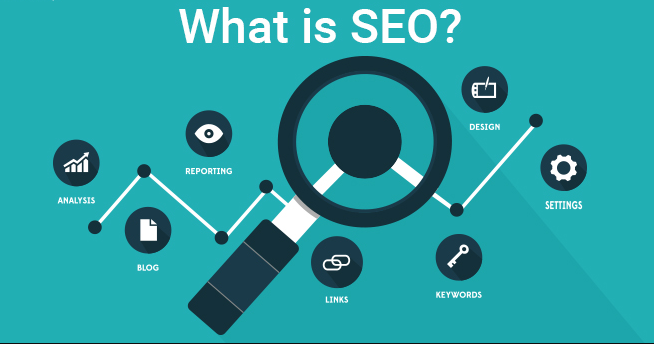
SEO, or Search Engine Optimization, is the practice of improving your website so it appears higher in traditional search engine results like Google or Bing. When someone types a query into a search bar, SEO is what determines whether your page shows up near the top of the results — or gets buried on page five, where no one scrolls.
The core goal is simple: drive more organic traffic to your site by ranking higher for relevant keywords.
To achieve that, SEO relies on a mix of strategies:
- Keyword research — finding the exact terms your audience searches for
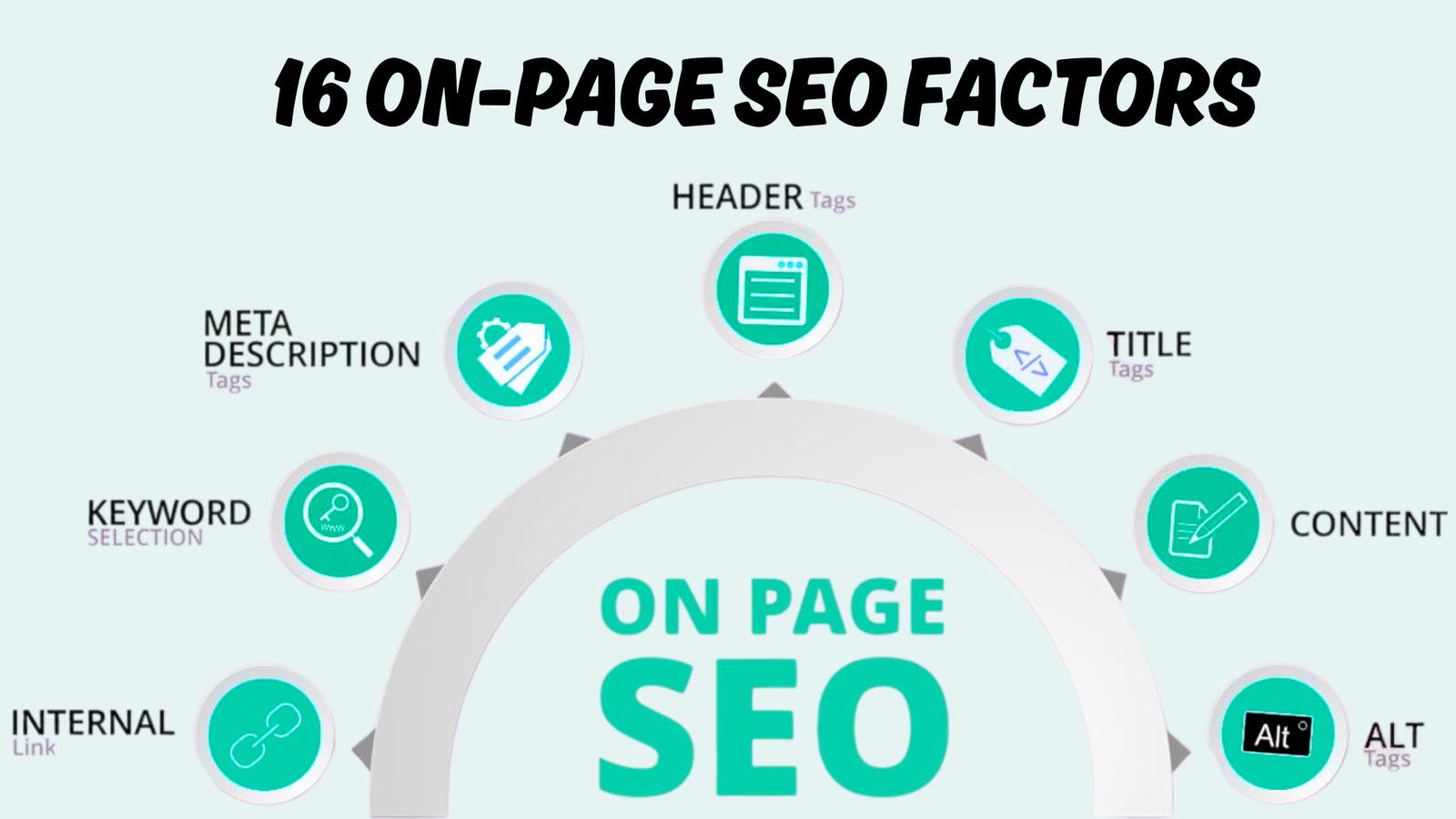
- On-page optimization — titles, meta descriptions, headers, and content structure
- Technical SEO — site speed, mobile-friendliness, crawlability, and indexability
- Backlink building — earning links from other credible websites to boost authority
- Content creation — publishing helpful, in-depth pages that match search intent
When SEO is working well, you see more clicks, better keyword rankings, and stronger organic traffic over time. It’s a proven long-term investment that most businesses already rely on.
What Is GEO?
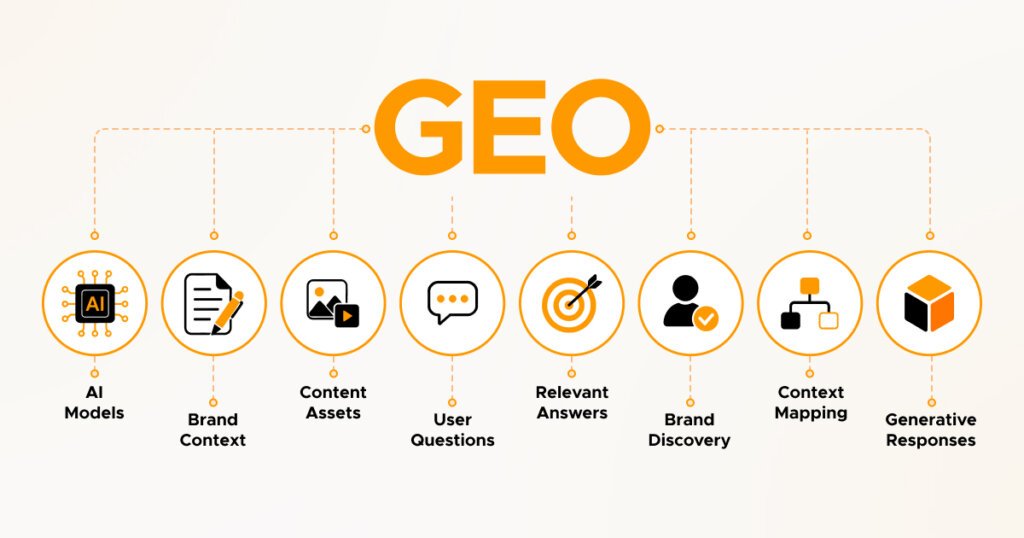
GEO stands for Generative Engine Optimization. It’s a newer practice focused on making your content show up inside the answers that AI-powered tools generate — platforms like ChatGPT, Google AI Overviews, Perplexity, and Microsoft Copilot.
Instead of clicking through a list of search results, users today often ask a conversational question and get a full, synthesized answer in seconds. GEO is about making sure your brand or content is part of that answer.
Think of it this way: SEO earns you a spot on the results page. GEO earns you a mention inside the actual response.
GEO optimization focuses on:
- Structured, scannable content — headers, bullet points, FAQs, and numbered lists that AI can easily parse and extract
- Factual accuracy — AI tools favor content they can confidently cite, so credibility matters more than ever
- Entity authority — building your brand’s presence and reputation across the web so AI systems recognize you as a trusted source
- Conversational language — writing in a way that matches how people phrase natural language questions
- Original insights — unique data, research, and direct answers that add real information gain to the topic
GEO success isn’t measured in rankings or click-through rates. It’s measured in how often AI tools mention, reference, or cite your content when answering relevant questions.
SEO Vs GEO: The Core Differences
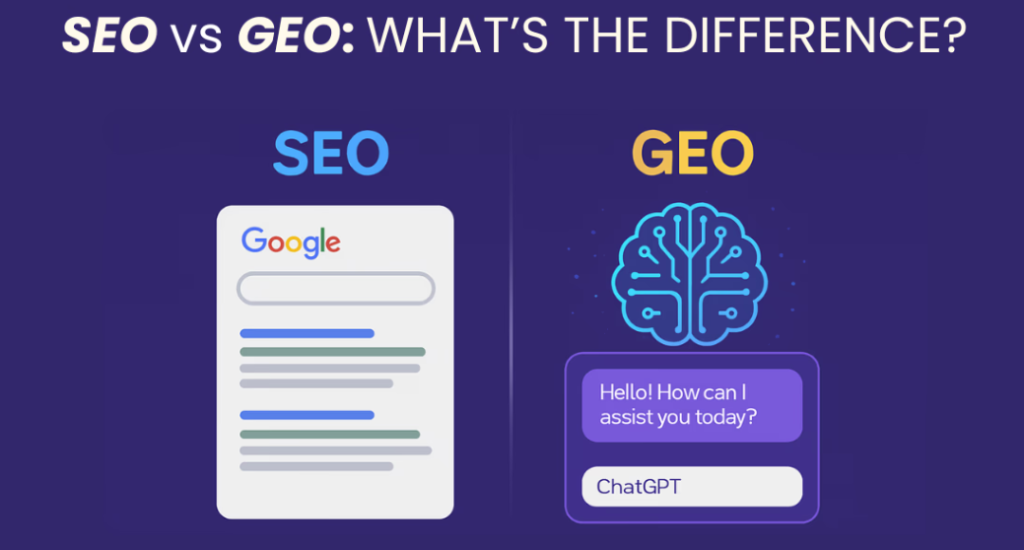
The difference between SEO and GEO starts with the platform they target and ends with how success is measured.
SEO is designed for traditional search engines like Google and Bing. GEO targets generative AI platforms like ChatGPT, Perplexity, Gemini, and Google’s AI Overviews.
In traditional SEO, a user types a short keyword, gets a list of links, and clicks the one that looks most relevant. In GEO, a user asks a full question in plain language and receives a direct, synthesized answer — often without ever clicking a link at all.
That shift changes almost everything about how you optimize content.
With SEO, you’re competing for a position on a ranked results page. With GEO, there’s no fixed position. AI either includes your content in its response or it doesn’t. The competition isn’t about rank — it’s about being citation-worthy enough for the AI to pull from.
User queries are also noticeably different. Traditional SEO queries average around four words. Conversational AI prompts average around 23 words. That means GEO content needs to be written for depth and direct answerability, not just keyword insertion.
SEO Vs GEO: Full Comparison
| Factor | SEO | GEO |
|---|---|---|
| Full Form | Search Engine Optimization | Generative Engine Optimization |
| Target Platform | Google, Bing, Yahoo | ChatGPT, Perplexity, Gemini, AI Overviews |
| Primary Goal | Rank higher in SERPs | Get cited in AI-generated answers |
| Output for Users | A list of links to click | A synthesized, direct text answer |
| Query Format | Short keyword phrases (~4 words avg.) | Conversational questions (~23 words avg.) |
| Optimization Focus | Keywords, backlinks, page structure | Clarity, structured data, factual accuracy |
| Success Metrics | Rankings, CTR, organic traffic | AI citations, brand mentions, AI share of voice |
| Content Style | Keyword-rich, intent-matched pages | Direct answers, question-format, scannable structure |
| Authority Signals | Backlinks from credible sites | Expert mentions, original research, entity recognition |
| Traffic Outcome | Users click through to your website | Brand visibility in AI answers (often zero-click) |
| Technical Focus | Crawlability, meta tags, page speed | Schema markup, entity graph, clean HTML for AI parsing |
| E-E-A-T Role | Required for rankings | Even more critical — AI trusts well-established, verified sources |
How SEO and GEO Are Similar
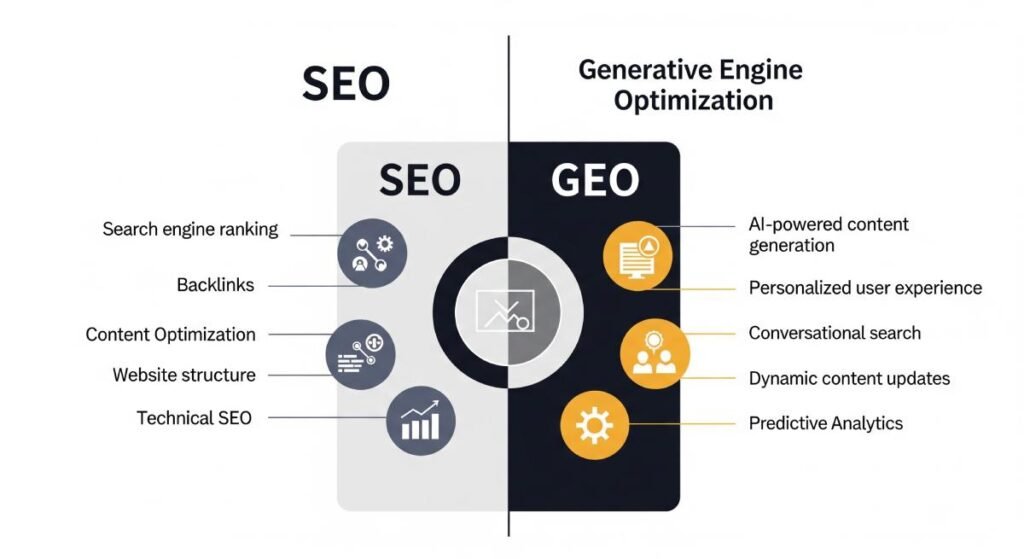
Despite their differences, SEO and GEO share the same foundation — and that’s important to understand.
Both reward high-quality, helpful content. Both penalize thin, keyword-stuffed pages that don’t genuinely answer the reader’s question. Both care deeply about Google’s E-E-A-T framework: Experience, Expertise, Authoritativeness, and Trustworthiness.
If your site is hard to navigate, vague about what you offer, or lacks credibility signals, you’ll struggle with both SEO and GEO at the same time.
The biggest overlap? Clean site architecture, strong topical authority, and content that’s genuinely useful to real people. Build that, and you’re laying the groundwork for success in both channels. GEO isn’t asking you to start over — it’s asking you to go deeper and be more direct.
GEO Vs SEO: Pros and Cons
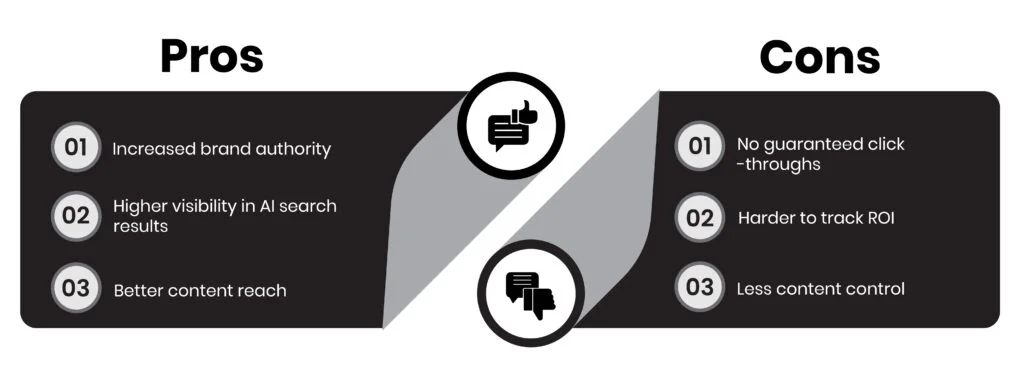
Understanding the seo vs geo pros and cons helps you make smarter decisions about where to invest your time.
SEO: Pros
- Proven track record — decades of data, tools, and case studies to learn from
- Direct traffic — successful rankings bring visitors straight to your website
- Measurable results — clear KPIs like rankings, sessions, and conversions
- Long-term compounding — a strong piece of content can drive traffic for years
- Local visibility — Google Business Profile and local SEO remain highly effective for location-based searches
SEO: Cons
- Increasingly competitive — top spots are harder to earn as more businesses optimize
- AI search is reducing organic clicks — organic click-through rates have dropped significantly as AI Overviews take up more of the page
- Slow results — building rankings takes months, sometimes longer
- Algorithm dependency — a single Google update can shift your traffic overnight
GEO: Pros
- Future-proofing your brand — AI search adoption is growing fast, and early movers have an edge
- Zero-click brand authority — your brand gets mentioned even when no one clicks
- Less competition right now — most businesses aren’t optimizing for GEO yet
- Conversational reach — reaches users who skip Google entirely and go straight to AI tools
- Works for any funnel stage — great for awareness, consideration, and decision-stage content
GEO: Cons
- No guaranteed traffic — AI citations don’t always result in direct site visits
- Hard to measure — tracking AI mentions and citations requires newer tools
- Evolving landscape — best practices are still being refined as AI platforms change
- Dependent on SEO foundation — without a credible website and content base, GEO efforts won’t gain traction
SEO Vs GEO Strategies
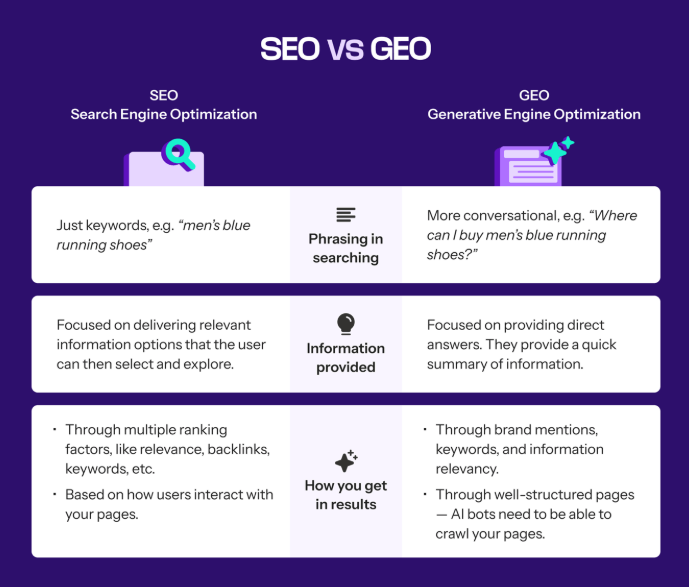
Getting results from either channel comes down to applying the right tactics. Here’s what actually works for each.
Winning SEO Strategies in 2026
- Build topical authority by covering your niche in full depth, not just individual keywords
- Earn backlinks from relevant, high-authority sites in your industry
- Optimize page experience — fast load times, mobile usability, and clear navigation
- Use structured data (schema markup) to help search engines understand your content
- Target featured snippet opportunities with clear, direct answers to common questions
- Keep content fresh with regular updates to signal relevance to Google’s crawlers
Winning GEO Strategies in 2026
- Write content that directly answers questions — lead with the answer, not the setup
- Use headers, bullet points, numbered lists, and comparison tables to make content easy for AI to extract
- Add original data, statistics, and expert insights — AI rewards information gain, not rephrased summaries
- Build brand mentions across credible platforms: podcasts, industry publications, forums, and social channels
- Use FAQ sections on key pages to capture conversational queries
- Maintain consistent, accurate information about your business across all online platforms (AI cross-references sources)
- Implement structured data for entities, products, and FAQs to improve AI recognition of your brand
Traditional SEO Vs AI Search Optimization: How Search Has Changed
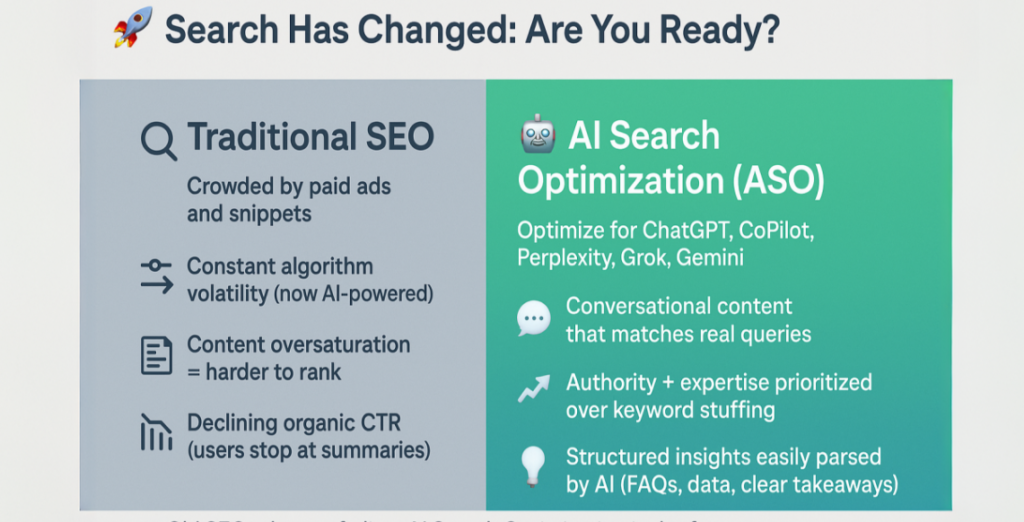
The shift from traditional SEO to AI search optimization isn’t a sudden replacement. It’s an evolution.
For years, ranking on Google was the primary goal for online visibility. But today, a growing number of users skip the search results page entirely and ask AI tools their questions directly. Studies show that over 71% of people now use AI tools for search queries, and 80% of consumers use AI summaries for more than 40% of their searches.
That behavioral change has real consequences. Organic click-through rates have dropped significantly as AI Overviews and direct AI answers take the spotlight away from traditional blue-link results.
Traditional SEO still matters — 76% of AI Overview citations actually come from pages already ranking in the top 10 organic results. That means your SEO foundation directly feeds your GEO visibility. A strong SEO strategy makes your content more likely to be pulled into AI responses in the first place.
The key difference in how you think about it: traditional SEO optimization asks, “How do I get people to click my link?” AI search optimization asks, “How do I become the source the AI trusts?”
SEO Vs GEO 2026: Which One Should You Focus On?
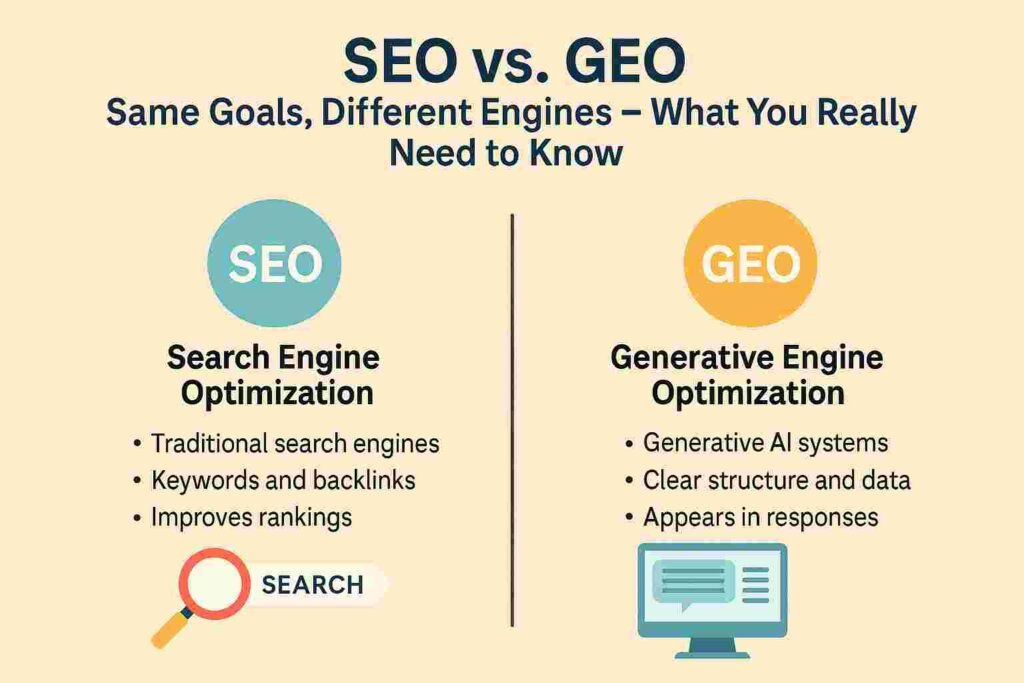
This is the question every digital marketer, business owner, and content strategist is asking right now. And the honest answer is: you shouldn’t have to choose between them.
SEO and GEO are not competing strategies. They’re complementary layers of the same goal — getting your brand in front of the right people at the right moment.
Here’s a practical way to think about it:
Prioritize SEO if:
- You’re building your online presence from scratch
- You rely heavily on organic website traffic for leads or sales
- You want to capture users actively searching for your product or service
- You’re targeting local customers through location-based searches
Prioritize GEO if:
- Your audience uses AI tools for research and buying decisions
- You operate in a content-driven, thought leadership-heavy space
- You want to establish brand authority in a competitive niche
- You’re looking to get ahead of competitors who haven’t invested in AI visibility yet
Do both if:
- You want long-term, sustainable visibility across traditional and AI search
- Your audience uses multiple platforms to research before making a decision
- You’re an agency, SaaS brand, or e-commerce business competing at scale
The smartest move in 2026 is to treat your existing SEO investment as the foundation, then layer GEO strategies on top of it. You’re not starting over — you’re extending your reach into a new search channel.
How GEO Builds on Your Existing SEO Work
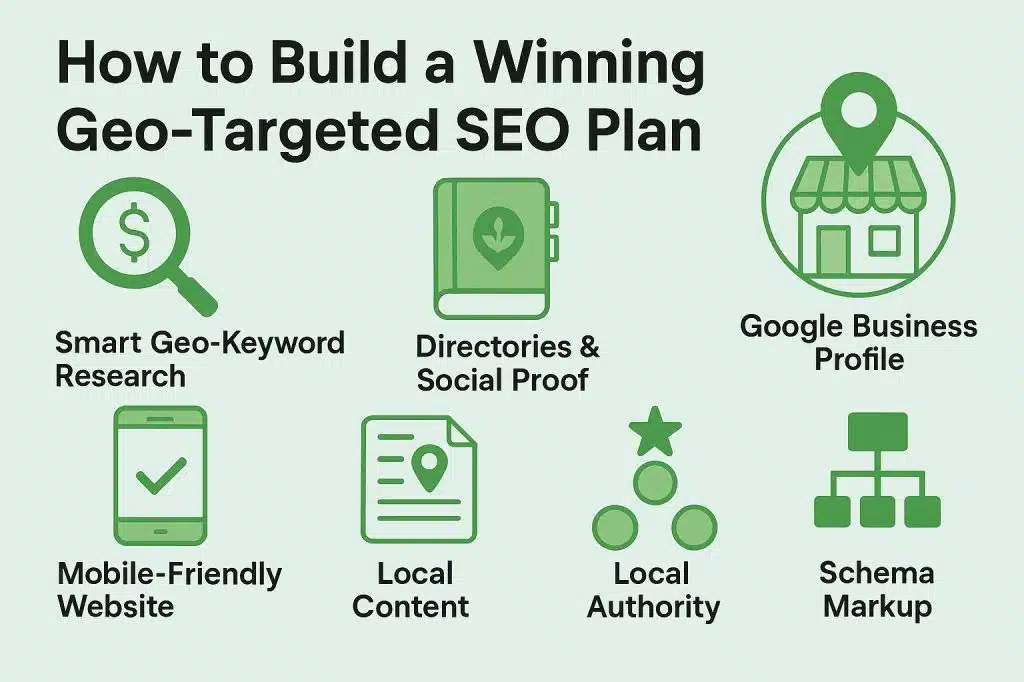
One of the biggest misconceptions about GEO is that it requires a completely separate content strategy. It doesn’t.
Most of what makes content good for SEO — clear structure, helpful information, credible sources, authoritative expertise — also makes content good for GEO. The difference is mostly in execution and emphasis.
For GEO, you need to go further:
- Make your content more direct. Don’t bury the answer in the fifth paragraph. Put it front and center.
- Add more factual depth. Include real statistics, original observations, and specific examples that AI tools can confidently reference.
- Strengthen your brand’s presence off-site. AI systems build trust partly based on how often your brand is mentioned in credible, external contexts.
- Structure pages for extraction. Use headers that mirror real questions. Add FAQ sections. Break information into bite-sized, clearly labeled chunks.
If you’ve already invested in strong SEO content, you likely have 60–70% of what you need for GEO. The remaining work is mostly about refining and extending what’s already there.
Measuring Results: SEO Vs GEO KPIs
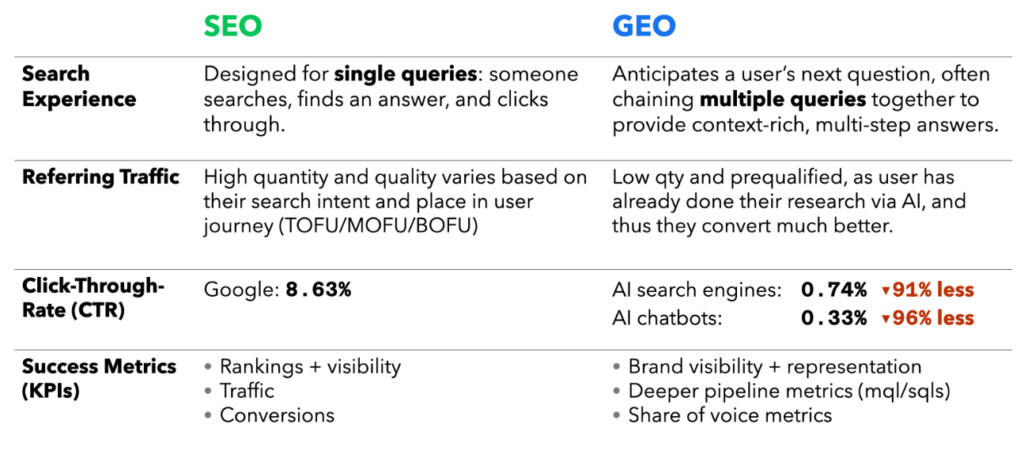
How you measure success looks different depending on which channel you’re focused on.
SEO metrics to track:
- Keyword rankings across target terms
- Organic traffic from search engines
- Click-through rate (CTR) from SERPs
- Backlink profile growth and authority
- Bounce rate and time on page
- Conversions from organic traffic
GEO metrics to track:
- Brand citation frequency in AI-generated answers
- AI referral traffic (traffic from tools like Perplexity)
- AI share of voice — how often you appear vs. competitors in AI responses
- Inclusion rate in Google AI Overviews for target topics
- Brand mention volume across the web
- Visibility in AI tools for key industry queries
Most traditional SEO tools are starting to add GEO tracking features, but dedicated AI visibility tools are also emerging to help marketers measure citation rates and AI share of voice specifically.
Why Getting Both Right Is the Competitive Edge in 2026
The businesses that will win the most visibility over the next few years aren’t choosing between SEO and GEO. They’re doing both, intentionally, with a unified content strategy.
Here’s the reality: if your competitor is showing up in AI-generated answers and you’re not, they’re building trust with potential customers before those customers ever reach a search results page. That’s a brand authority gap that compounds over time.
On the other hand, businesses that abandon SEO in favor of GEO-only strategies are leaving direct website traffic, local visibility, and conversion-driven search intent on the table.
The most effective seo vs geo strategy isn’t a tradeoff. It’s a combination. Write content that ranks on Google and gets cited by AI. That’s not harder — it’s just smarter.
Stop Guessing — Build a Search Strategy That Works for Both
The bottom line on SEO vs GEO is this: they target different platforms, measure success differently, and require different content approaches — but they share the same foundation, and they’re most powerful when used together.
SEO gives your content the authority and structure needed to rank in traditional search. GEO takes that authority and extends it into the AI-powered conversations your audience is already having. Skip one, and you leave visibility — and revenue — on the table.
If you’re unsure where your current strategy is falling short, that’s exactly the kind of problem a results-focused SEO expert can help you solve. At SEO Visibility, Khalid Hussain has spent 15+ years helping businesses, agencies, and e-commerce stores grow their online presence — and now he helps brands adapt to the new AI-driven search landscape too.
Whether you need to strengthen your SEO foundation, start building GEO visibility, or create an integrated strategy that covers both, getting expert guidance means you’re not leaving your rankings or AI citations to chance.


![How Much Does an SEO Expert Cost in 2026 [SEO Pricing]](https://seovisibility.co/wp-content/uploads/2026/01/how-much-does-an-seo-expert-cost.png)
![SEO Copywriting Checklist [Easy to Follow Guidelines]](https://seovisibility.co/wp-content/uploads/2026/01/seo-copywriting-checklist.png)