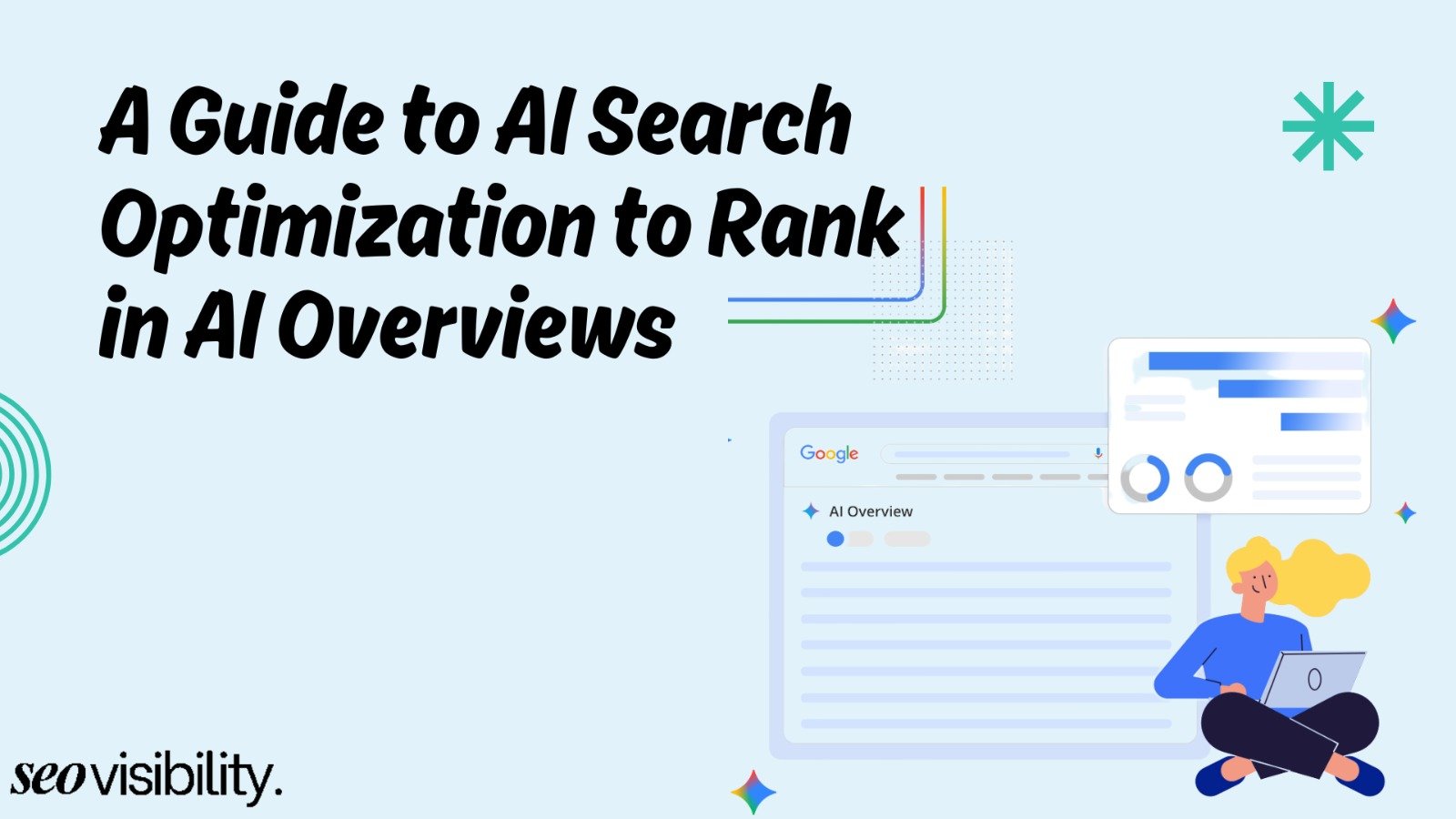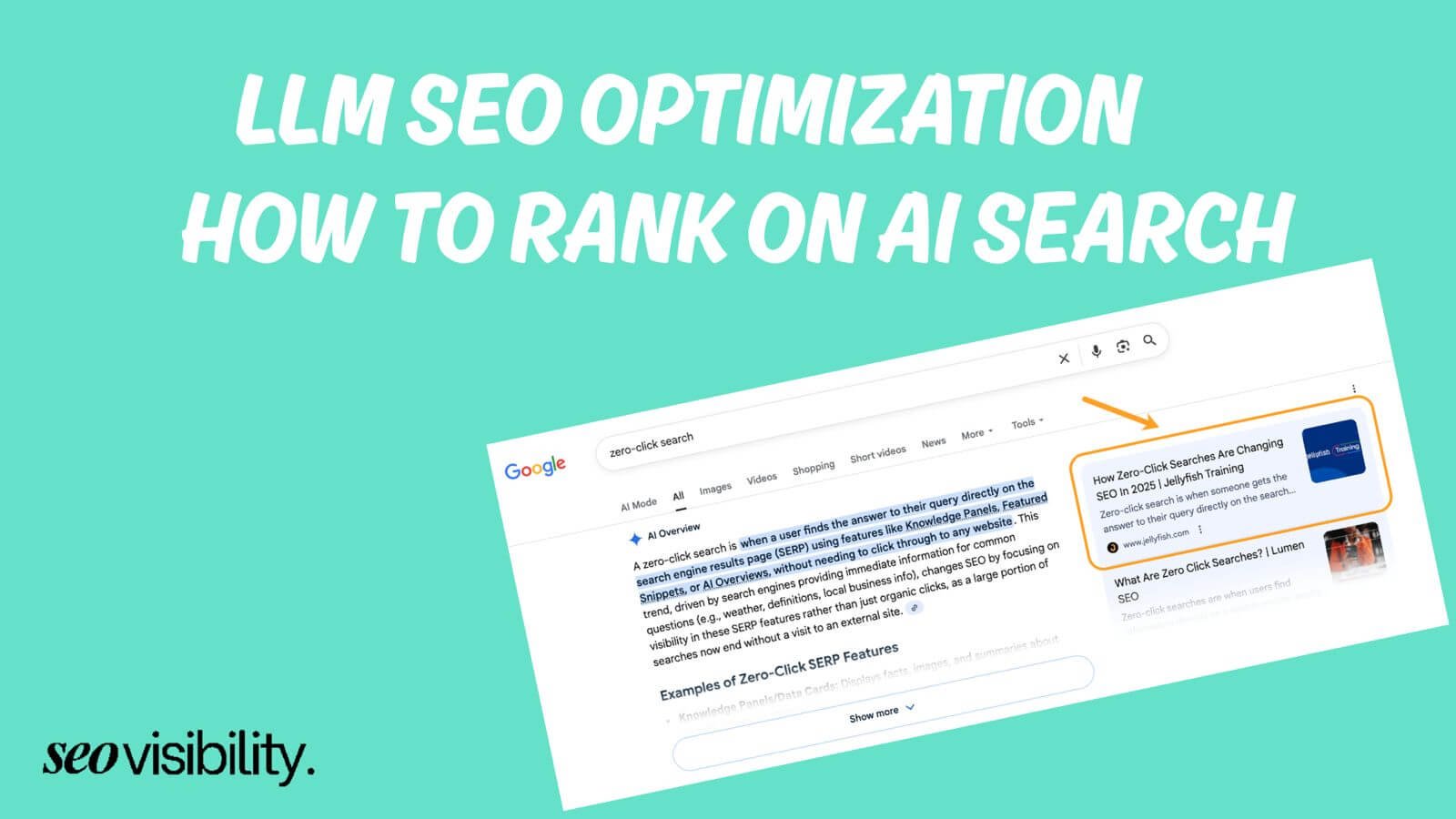
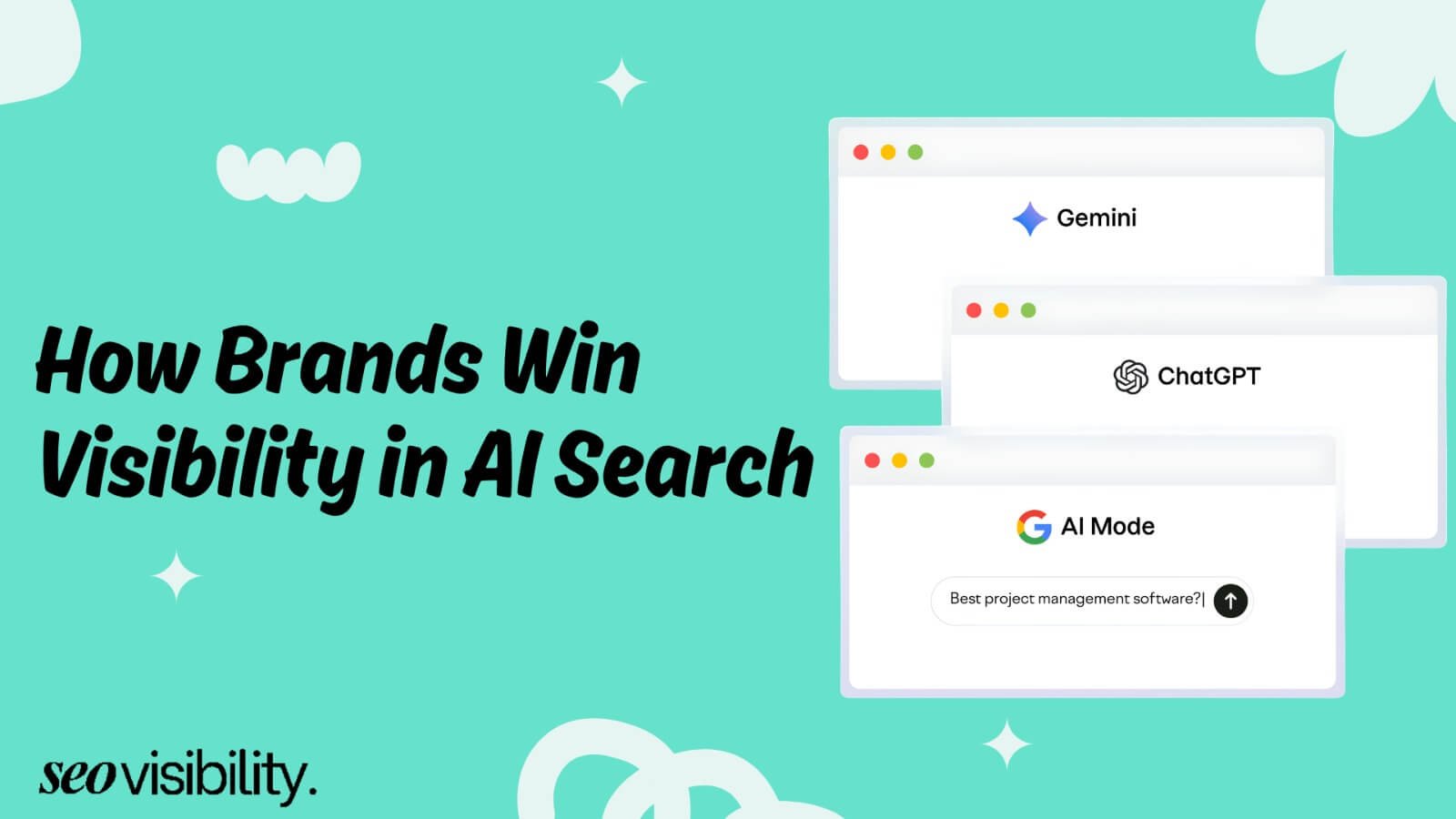
Brands win visibility in AI search by building entity authority, structuring content for easy extraction, earning third-party mentions across the web, and staying consistent across every platform where AI systems go to learn about them.
Unlike traditional SEO, AI search optimization is not about ranking a single page. It is about becoming the brand that AI trusts enough to cite when someone asks a question in your space.
What is AI Search Visibility?
AI search visibility is how often and how prominently your brand appears in responses generated by AI-powered search tools like ChatGPT, Google AI Overviews, Perplexity, and Microsoft Copilot.
These tools do not show a list of blue links. They generate a direct answer, and if your brand is not part of that answer, you are invisible to a growing segment of your audience.
Why is AI Search Visibility important?
AI search traffic has grown 9.9x in the past 19 months, with 92.4% coming from ChatGPT alone. Google AI Overviews now appear in 99.9% of informational keyword searches. AI Mode surpassed one billion monthly active users globally in 2026. These are not future projections. They are current numbers that marketing teams need to act on right now.
The stakes are high for brands that sit this out. An analysis of 177 brands across healthcare, SaaS, and financial services found that 90% of brands have zero AI search mentions. That means only 10% of brands are showing up where more and more buyers are starting their research.
Brands appearing in ChatGPT recommendations were 2.5x more likely to receive a site visit within 7 days than brands not recommended.
The shift from traditional search to AI-powered discovery is not something that is coming. It is already reshaping how buyers find brands, compare options, and make decisions. 51% of B2B software buyers now start their research with an AI chatbot more often than with Google.
35% of users say AI is more useful than search engines for discovering new brands. 85% of buyers think more highly of a software vendor when AI includes them in an answer.
The brands that are winning in AI search right now are not waiting for the landscape to stabilize. They are building entity authority, earning third-party mentions, structuring content for extraction, and monitoring their citation presence across every major platform. That is what an AI search strategy looks like in 2026.
AI search traffic is still relatively small as a share of total web traffic, but it is growing 165x faster than organic search traffic. The compounding advantage goes to brands that start now.
How AI Search Engines Work?
To win in AI search, you need to understand how these AI search engines work. Most marketers treat AI search optimization the same way they treat traditional SEO, and that is exactly why they are not getting cited.
Parametric Memory Vs Live Retrieval
Every large language model operates from two knowledge pools. The first is parametric memory, everything the model absorbed during training. The second is real-time retrieval through a system called Retrieval-Augmented Generation (RAG), where the model searches the web to pull live content into its response.
Here is the critical part: ChatGPT enables search on only 34.5% of queries as of early 2026, meaning most responses still rely on training data alone. This means that for the majority of queries, no amount of content optimization will get you cited because the citation mechanism was never switched on.
For these queries, what matters is whether your brand exists in the model’s memory strongly enough to be surfaced by default.
This creates two separate games that brands need to play at the same time. The first is building parametric authority so the model knows who you are before the query happens. The second is optimizing for RAG so that when the model searches, your content survives the retrieval pipeline.
4 Stages to Get Cited by AI (LLMs)
When retrieval is triggered, your content goes through four stages before it earns a citation.
Stage 1 – Query Fan-Out: The model turns one user question into 8 to 12 parallel sub-queries. A brand that shows up consistently across multiple related intents will outperform a brand that ranks first for only one of them. Research shows that for a keyword with 1,000 monthly searches in AI Mode, the total addressable retrieval surface expands to 8,000 to 12,000 opportunities once fan-out is accounted for.
Stage 2 – Chunking and Retrieval: The model does not read your page like a human. It breaks content into fragments and only evaluates chunks that stand alone as self-contained units. Dense, unbroken paragraphs frequently fail at this stage. Analysis of 1.2 million ChatGPT answers found that 44.2% of citations come from the first 30% of the content. Leading with the answer is not just a formatting preference. It is a citation requirement.
Stage 3 – Passage Selection: This is where the model compares all retrieved candidates and scores how well each passage supports the claims in its answer. Content with self-contained, direct-answer sections of 50 to 150 words receives 2.3x more citations than long-form unstructured content.
Stage 4 – Attribution: Even if the model used your content, you only get credit if your brand entity is clear and consistent. If your brand name is used differently across your site and third-party sources describe you in conflicting ways, the model may attribute your content to a competitor or to no source at all.
The Difference Between AI Search Platforms
Not all AI search engines work the same way, and this is a gap that most brands and even most agencies miss entirely. Optimizing for one platform does not automatically give you visibility on the others.
| Platform | Citation Style | Key Bias | Correlation with Google Rankings |
|---|---|---|---|
| ChatGPT | Parametric-heavy, cites 87% of the time | Training data entities, brand recognition | Low, 75% of cited domains don’t appear in Google or Bing |
| Perplexity | RAG-first, 2-3x more citations per query | Reddit, content published within the last 90 days | Moderate, favors niche authority content |
| Google AI Overviews | Retrieval via Google index | E-E-A-T, structured data, traditional organic rank | Highest, 76.1% of citations also rank in Google’s top 10 |
| Gemini | Conversational, mentions brands in 83.7% of responses | Brand knowledge is often cited without a link | Lower, dropping citations in “best” and “top” queries |
Only 2% of cited URLs appear across all three major platforms, AI Overviews, ChatGPT, and Perplexity, simultaneously. This means a platform-specific approach is not optional. It is the foundation of any serious AI search strategy.
The Core Ranking Factors for AI Search Visibility
Research across millions of AI responses has identified the factors that consistently predict whether a brand gets cited. These are not theories. They are backed by large-scale data.
Brand Search Volume and Parametric Authority
The strongest single predictor of AI citation likelihood is brand search volume, with a 0.334 correlation coefficient. This outranks all technical signals. Brands with millions of brand mentions on platforms like Reddit and Quora have roughly 4x higher chances of being cited by ChatGPT than those with minimal activity. Building a recognizable brand is, at its core, an AI search strategy.
Third-Party Presence and Entity Validation
Brands are 6.5x more likely to be cited through third-party sources than in their own domains. This is one of the most important statistics in AI search marketing. It means your website is not the primary place AI learns about you. The web is.
Domains with profiles on review platforms like Trustpilot, G2, Capterra, and Yelp have 3x higher citation probability than sites without them. The data on Trustpilot is particularly striking: brands with no profile have a median AI citation rate of 1%, while brands with even a minimal profile, as few as 1 to 13 reviews, jump to 53.5%. That is a 52 percentage point swing from a single platform action.
Earned media distribution expands AI visibility even further. Distributing content to a wide range of publications can increase AI citations by up to 325% compared to only publishing on your own site. Journalistic and earned media sources account for nearly 25% of all citations generated by large language models.
Content Structure and Answer Placement
Where you put the answer is one of the strongest levers for AI search optimization. Pages that state the direct answer in the first paragraph consistently outperform pages that build toward a conclusion. This is not just about featured snippets. It is about how AI extraction works.
Pages with FAQ schema and inline citations show roughly 40% higher citation weighting in ChatGPT source selection. Comparison pages with three or more tables earn 25.7% more ChatGPT citations. Shortlist pages averaging 10 words or fewer per sentence earn 18.8% more citations.
Content Freshness and Update Cadence
AI systems consistently prefer fresh content. Content updated in the past three months averages 6 citations versus 3.6 for outdated pages. Citation performance on newly published content can begin declining after just four to five days without updates. The most visible brands in competitive categories publish two or more structured content pieces per week.
This is a significantly faster cadence than traditional SEO demands. Brands that built their strategy around quarterly content calendars need to rethink that model for AI search discoverability.
Named Entities and Claim Density
AI models extract and attribute specific, verifiable claims far more reliably than generalizations. Heavily cited text averaged 20.6% entity density, three to four times normal English prose. Every major section of your content should contain at least one claim specific enough to be extracted and attributed.
Adding statistics to content increases AI visibility by 22%. Including prominent pull quotes increases citation rates by 37%. Original research pages average 11.3 citations versus 3.4 for non-primary pages, which is 3.3x more citation-dense.
Technical Accessibility for AI Crawlers
AI crawlers like GPTBot, ClaudeBot, and PerplexityBot do not execute JavaScript and do not follow link graphs for authority signals. Critical content in JavaScript-rendered sections, gated behind paywalls, or blocked in robots.txt simply does not exist for AI retrieval systems. Pages with fast-loading times are 3x more likely to be cited by ChatGPT than slower pages.
AI SEO Vs Traditional SEO
Understanding how AI SEO differs from traditional SEO is essential before building your strategy. These are not the same discipline, though they share some foundations.
| Factor | Traditional SEO | AI Search Optimization |
|---|---|---|
| Primary Goal | Rank on the search results page | Get cited in an AI-generated answer |
| Key Ranking Signal | Backlinks and keyword usage | Brand mentions, entity clarity, content structure |
| Content Format | Optimized for crawlers and humans | Structured for extraction and chunking |
| Off-Site Signals | Backlinks from authority sites | Mentions on review sites, forums, publications |
| Content Length | Longer content often performs better | Self-contained sections of 50-150 words perform better |
| Freshness | Helpful but not critical | Major factor, content decays within days |
| Keyword Targeting | Keyword-match to query | Semantic coverage across topic clusters |
| Measurement | SERP rank, organic traffic | AI citation rate, AI referral traffic, brand mentions |
| Platform | Google primarily | ChatGPT, Perplexity, Gemini, AI Overviews, Copilot |
Importantly, 80% of LLM citations do not rank in Google’s top 100 for the original query. This means strong traditional SEO does not automatically translate to AI search visibility, especially outside of Google’s own AI products.
Practical AI Search Strategy Framework to Dominate AI Search Results
Building AI search visibility requires a structured approach, not a list of tactics. Here is a framework that works across platforms.
Step 1 – Audit Your Current AI Visibility
Before optimizing, you need to know where you stand. Search your brand name and your core buying questions across ChatGPT, Perplexity, Google AI Overviews, and Gemini. Note which competitors are being cited and which questions your brand is absent from entirely. This audit tells you which stage of the citation pipeline is your biggest failure point.
Step 2 – Establish Entity Consistency
Your brand name, product names, and category descriptions need to be consistent everywhere they appear, on your site, in your profiles, in your PR, and on third-party platforms. Entity inconsistency is one of the most common reasons brands fail at the attribution stage of the citation pipeline. Choose how you describe your brand and lock it down across every surface.
Step 3 – Build a Third-Party Presence
Start with the platforms that have the highest correlation with AI citations: Google Business Profile, Trustpilot, G2, Capterra, and LinkedIn. Then pursue earned media placements in publications that AI systems treat as authoritative. You want your brand mentioned alongside your category keywords in places AI crawls regularly.
YouTube is also a top factor. YouTube and branded web mentions are the top signals correlating with AI brand visibility in ChatGPT, AI Mode, and AI Overviews. A YouTube presence is no longer just a content channel. It is an AI authority signal.
Step 4 – Restructure Content for AI Extraction
Every key page on your site needs to follow the same structure: lead with a direct answer, use short self-contained sections, include question-based headings, and add specific named claims with data. This applies especially to comparison pages, listicles, and how-to guides, which are the content types most frequently cited in AI responses.
For commercial intent queries, which drive most buying decisions, listicles account for 59.5% of all AI-cited URLs in competitive categories. If you are not producing structured comparison and ranking content, you are structurally disadvantaged in AI search discoverability.
Step 5 – Cover Topic Clusters, Not Just Keywords
Because AI fan-out generates 8 to 12 sub-queries from every single user prompt, single-page keyword targeting is insufficient for AI search ranking. Brands that maintain broad topical coverage across a cluster are far more resilient to fan-out variation. Only 27% of fan-out sub-queries remain consistent across different searches, which means topic depth protects you when the specific sub-queries shift.
Step 6 – Publish Consistently and Update Regularly
Fresh content is a major ranking factor across all major AI models. Brands serious about AI search presence treat content publishing the way growth-stage companies treat product iteration. Twice a week is the cadence the data supports for competitive categories.
Beyond new content, keep existing pages current. Set a review schedule. Add a visible “last updated” date. These signals directly influence retrieval probability.
Step 7 – Monitor and Iterate Monthly
40 to 60% of citation patterns change month over month as models update and training data shifts. AI search visibility is not a set-and-forget optimization. The brands maintaining consistent presence are actively monitoring how they appear in AI answers and adjusting their content and entity signals accordingly.
Mistakes to Avoid When Getting Visibility in AI Search
Most brands approaching AI search visibility make the same set of mistakes. Avoiding them saves months of wasted effort.
Optimizing only for Google AI Overviews. Because Google AI Overviews correlate most strongly with traditional search rankings, some SEOs assume their existing work covers AI search. It does not. Only 2% of cited URLs appear across ChatGPT, Perplexity, and AI Overviews simultaneously. Each platform requires a distinct approach.
Ignoring parametric memory. Most AI search content advice focuses entirely on content structure and RAG optimization. But 34.5% or fewer of ChatGPT queries even trigger a web search. For the rest, the question is whether your brand exists strongly enough in the model’s training memory to be recalled. Building that parametric presence requires sustained brand-building activity across the web, not just page optimization.
Treating AI citations as the end goal. Getting cited in volume means nothing if the citations are inaccurate or misattributed. Between 50% and 90% of LLM responses are not fully supported by the sources they cite. The goal is deliberate, accurate representation in AI answers that drive real outcomes, not just citation counts.
Publishing content without distribution. Brands that publish exclusively on their own site are getting only a fraction of the AI visibility available to them. Distributing the same content across multiple publications can increase AI citations by a median lift of 239%. Content distribution is no longer just a traffic strategy. It is an AI citation strategy.
Skipping the review platforms. The data on review platforms is too strong to ignore. Brands with fully optimized Trustpilot profiles received 9.5x more co-mentions than brands with no profile at all, meaning AI is recommending these brands when consumers are asking about someone else entirely.
Start Winning AI Search Visibility for Your Brand
Building AI search visibility is a strategic investment that returns over time. The earlier you start, the harder it becomes for competitors to displace you from AI-generated answers in your category.
The framework above gives you the foundation, but execution is where most brands stall. Knowing what to do and building a system that delivers consistent results across every AI platform are two different things.


![How Much Does an SEO Expert Cost in 2026 [SEO Pricing]](https://seovisibility.co/wp-content/uploads/2026/01/how-much-does-an-seo-expert-cost.png)