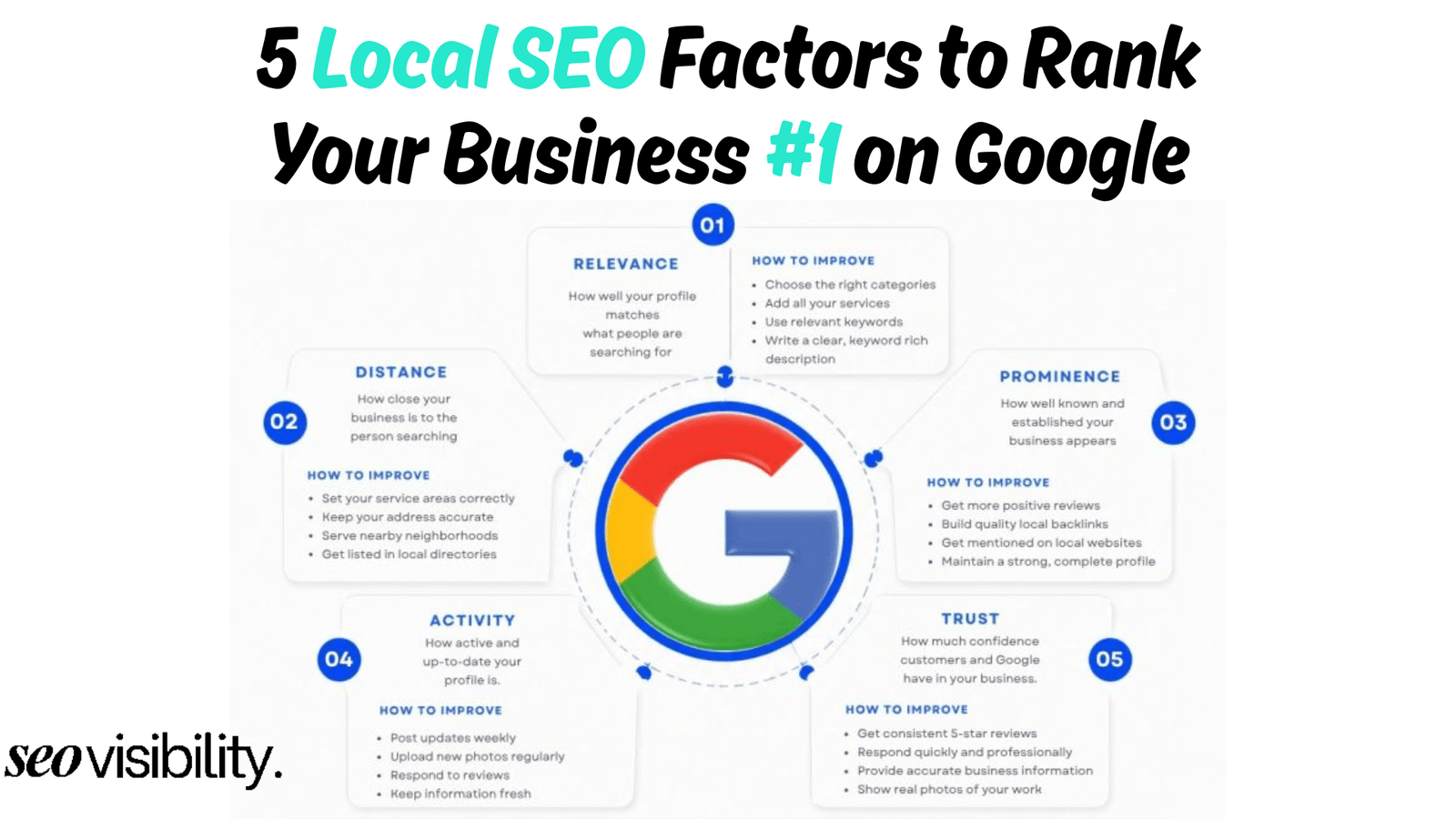
The top 5 local SEO factors that decide your Google ranking are relevance, distance, prominence, activity, and trust. Google uses these signals every time someone searches for a business near them, and the businesses that score highest on all five usually land in the local pack.
If you run a local business and you’re tired of watching competitors show up above you on Google Maps, this guide breaks down exactly what to fix. You’ll get a clear local SEO checklist you can start using today, no fluff, no guesswork.
Local SEO Ranking Factors – An Overview
Local SEO ranking factors are the specific signals Google checks before deciding which businesses appear in the local pack, the map results, and Google Maps for a given search.
Google’s own local ranking framework centers on three core pillars, relevance, distance, and prominence, and modern local search engine optimization has expanded that into practical categories that include activity and trust as well.
Every business gets ranked against these local search ranking factors for each search, which is why your ranking can look different for “plumber near me” versus “emergency plumber Dallas.”
Small business owners often assume a nice website is enough. In reality, most of the ranking weight sits inside your Google Business Profile and the trust signals surrounding it, not just your website content.
5 Local SEO Factors Help Your Business to Rank on Google
Local search drives real foot traffic and phone calls, and it happens fast. Someone searches, sees3 businesses in the map pack, and picks one within seconds.
If your business isn’t optimized for these local SEO factors, you’re invisible during that decision window.
A strong local SEO strategy fixes that by making sure your business shows up first, looks trustworthy, and gives searchers a reason to choose you over the competition.
Search intent behind local queries is rarely just informational. Someone searching “plumber near me” wants to call someone today, which is why Google local ranking factors weigh trust and prominence so heavily alongside relevance
This means a business with fewer reviews but perfectly matched relevance can still lose to a competitor with stronger prominence signals. Local search engine optimization works best when you treat all five factors as a system, not a checklist you complete once and forget.
1. Relevance
Relevance measures how well your Google Business Profile matches the exact search someone types in. Google reads your categories, services, description, and even customer reviews to decide if your business fits the query.
This is one of the biggest local seo factors because it filters out businesses that don’t actually offer what the searcher needs. A bakery that only sells categories under “restaurant” might miss out on searches for “custom cakes near me,” even if that’s their specialty.
How to Improve Relevancy
Choose the right categories. Pick a primary category that describes your core business first, then add secondary categories for every other service you offer.
Add all your services. List every service you provide inside your Google Business Profile, not just the main one. This helps you show up for more specific, long-tail searches.
Use relevant keywords. Naturally include your primary keyword and related local search terms in your business description and posts, without stuffing them awkwardly.
Write a clear, keyword-rich description. Your business description should explain what you do, who you serve, and where you serve them in plain language. Avoid vague statements and get specific about your offerings.
2. Distance
Distance is about proximity, how near your business location is to the person searching or to the location they typed into the search. Google can’t move your building, but it can decide how far a search will still show you based on your service area settings.
This factor explains why the same business can rank #1 on Google Maps for people three blocks away and disappear entirely for someone across town.
How to Improve Distance
Set your service areas correctly. If you’re a service-based business without a storefront, define your service area precisely so Google knows exactly where to show you.
Keep your address accurate. A wrong or outdated address confuses Google and searchers alike, which can quietly tank your visibility.
Serve nearby neighborhoods. Mention specific neighborhoods, suburbs, or districts you serve in your website content and Google posts, not just your city name.
Get listed in local directories. Local directories reinforce your location data across the web, which strengthens Google’s confidence in where you actually operate.
3. Prominence
Prominence reflects how established, trusted, and well-known your business appears both online and offline. Google looks at your review count, review quality, backlinks, citations, and general web presence to judge this.
This is often the factor that separates a business ranking #1 on Google Maps from one stuck in position five, even when both businesses are equally close to the searcher.
How to Improve Prominence
Get more positive reviews. Reviews feed directly into prominence, and businesses with more reviews and higher ratings consistently outperform competitors in the local pack.
Build quality local backlinks. Links from local news sites, chambers of commerce, or industry associations tell Google your business matters in your area.
Get mentioned on local websites. Sponsorships, community involvement, and local press coverage all add up as prominence signals over time.
Maintain a strong, complete profile. A fully filled-out Google Business Profile, with hours, photos, attributes, and services, signals legitimacy compared to a half-finished one.
4. Activity
Activity measures how often you update your Google Business Profile and how engaged you are with your audience. A stale profile that hasn’t been touched in months sends a weak signal, even if everything else looks good.
Google rewards businesses that show ongoing effort because it suggests the business is actually open, active, and paying attention to customers.
How to Improve Activity
Post updates weekly. Google posts about offers, events, or news keep your profile active and give searchers a reason to engage.
Upload new photos regularly. Fresh photos of your storefront, team, and work keep your profile visually current and build trust at the same time.
Respond to reviews. Responding to every review, good or bad, is one of the clearest activity signals you can send Google.
Keep information fresh. Update your hours, holiday closures, and service details as soon as anything changes, rather than letting outdated info sit for months.
5. Trust
Trust is about how much confidence both customers and Google place in your business. It overlaps with prominence but focuses specifically on consistency, accuracy, and authenticity rather than just visibility.
A business can have plenty of reviews and still lose trust if the rating is low, the information is inconsistent, or the photos look fake or outdated.
How to Improve Trust
Get consistent 5-star reviews. Steady, ongoing reviews matter more than a one-time burst, since Google favors consistent growth over sudden spikes.
Respond quickly and professionally. Fast, polite responses to reviews, especially negative ones, show both customers and Google that you’re engaged and reliable.
Provide accurate business information. Your name, address, and phone number, known as NAP consistency, must match exactly across your website, Google profile, and every directory listing.
Show real photos of your work. Authentic photos of your actual location, team, and completed jobs build far more trust than generic stock images.
Local SEO Ranking Factors Comparison
| Factor | What It Measures | Fastest Way to Improve It |
|---|---|---|
| Relevance | How well your profile matches the search | Add accurate categories and a detailed service list |
| Distance | How close you are to the searcher | Set the correct service areas and address |
| Prominence | How well-known your business is | Earn more reviews and local backlinks |
| Activity | How current and engaged your profile is | Post weekly updates and new photos |
| Trust | Confidence from customers and Google | Keep NAP consistent and respond to reviews fast |
Local SEO Checklist to Rank #1 on Google
Use this quick local SEO checklist to audit your Google Business Profile this week.
- Verify your business categories match your actual services
- Confirm your NAP details are the same everywhere online
- Add the latest photos and at least 1 Google post.
- Manage your customers’ reviews and reply to every unanswered review
- Check that your service area or address is accurate
- Build at least three new local citation opportunities
Running through this checklist regularly is one of the simplest ways to strengthen every local SEO factor without hiring a large team or spending heavily on ads.
Hire a Local SEO Expert to Rank Your Local Business #1 on Google
Ranking your business in Google’s local pack takes consistent work across relevance, distance, prominence, activity, and trust, and most business owners simply don’t have the time to manage all five.
Khalid Hussain has spent 15+ years helping hundreds of local businesses climb to the top of Google’s local rankings, and he can build a local SEO strategy tailored to your business and city.
If you’re ready to stop losing calls and customers to competitors ranking above you, visit SEO Visibility and get a free local SEO audit from Khalid Hussain today.


![How Much Does an SEO Expert Cost in 2026 [SEO Pricing]](https://seovisibility.co/wp-content/uploads/2026/01/how-much-does-an-seo-expert-cost.png)


![SEO Copywriting Checklist [Easy to Follow Guidelines]](https://seovisibility.co/wp-content/uploads/2026/01/seo-copywriting-checklist.png)