You’ve installed WordPress. You’ve picked a theme. Now you’re staring at two of the most talked-about SEO plugins on the planet — Rank Math and Yoast SEO — wondering which one actually deserves a spot on your site.
Rank Math gives you more for free, while Yoast SEO is easier for complete beginners. But that’s just scratching the surface. The right choice depends entirely on your goals, your technical comfort level, and how serious you are about SEO.
Both plugins do the same job at the core — they help you optimize your WordPress content for search engines. But how do they go about it, what do they charge for it, and how much control do they give you? That’s where they differ significantly.
This guide breaks down every major difference between Rank Math SEO and Yoast SEO so you can make the right call without second-guessing yourself.
A Quick Analysis of Both WordPress SEO Plugins
Before diving into the feature-by-feature comparison, it helps to understand where each plugin is coming from.
Yoast SEO was launched back in 2010 by Joost de Valk and has been the undisputed heavyweight of WordPress SEO for over a decade. It currently sits at over 10 million active installations on WordPress.org, which makes it the most widely installed SEO plugin in the world. Yoast built its reputation on simplicity — the traffic light system, the readability score, the clean interface. It’s the plugin most people learn first.
Rank Math, on the other hand, is the newer player. It launched in November 2018 and almost immediately disrupted the space. Despite being years younger, Rank Math has grown to over 4 million active installations and has earned a 4.9-star rating on the WordPress plugin directory compared to Yoast’s 4.8. The reason? It packs a serious number of features into its free version — things competitors charge extra for.
Rank Math Vs Yoast: Free Version Comparison
This is where the gap between the two plugins becomes very clear. If you’re on the free tier, the experience is dramatically different.
| Feature | Rank Math Free | Yoast SEO Free |
|---|---|---|
| Focus Keywords per Post | Up to 5 | 1 |
| Content Analysis Checks | 30+ checks | 12+ checks |
| Schema Markup Types | 15+ types (free) | Basic (Article, WebPage only) |
| XML Sitemaps | Yes (configurable) | Yes (basic) |
| Redirections Manager | Yes (built-in) | No — Pro only |
| Google Search Console Integration | Yes (built-in) | No |
| 404 Monitor | Yes | No |
| Local SEO | Basic (free) | No — separate add-on |
| Social Media Meta (OG, Twitter) | Yes | Yes |
| Breadcrumbs | Yes | Yes |
| Image SEO | Yes | No |
| Internal Link Suggestions | Basic (free) | No — Pro only |
The numbers above tell a clear story. Rank Math’s free version includes redirections, 404 monitoring, Google Search Console integration, and 5 focus keywords per post — all features that Yoast keeps behind its paid wall.
For someone building their first website or running a blog on a budget, that’s a meaningful difference.
Rank Math also wins on content analysis depth. Its free version runs through 30+ optimization checks on each post, compared to Yoast’s 12+ checks. That means more actionable feedback when you’re writing and optimizing content.
Rank Math Vs Yoast: Premium Version Comparison
When you go paid, both plugins unlock a lot more. But the pricing structures are quite different.
| Feature | Rank Math Pro | Yoast SEO Premium |
|---|---|---|
| Price (1 site) | $6.99/month (billed annually) | $9.90/month (billed annually, ~$118.80/year) |
| Focus Keywords | Unlimited | Unlimited (with synonyms) |
| Keyword Rank Tracking | Yes (500 keywords) | Via Wincher integration |
| Schema Generator | Advanced (custom schemas) | Structured data blocks |
| Analytics Dashboard | Built-in | No — separate add-on |
| AI Content Suggestions | Yes (Content AI, trial credits) | Yes (AI Generated) |
| Advanced Redirections | Regex, conditional rules | Basic redirections |
| Internal Linking | Suggestions + counter | Suggestions |
| WooCommerce SEO Pro | Yes | Yes |
| 24/7 Support | Yes | Yes |
| Google Docs Integration | No | Yes (1 free seat) |
Rank Math Pro comes in noticeably cheaper than Yoast SEO Premium. And it includes a built-in analytics dashboard — something Yoast doesn’t offer without a separate integration.
Rank Math Pro also lets you track up to 500 keywords directly inside the plugin dashboard, while Yoast relies on its Wincher integration to do the same.
One place Yoast pulls ahead at the premium level is Google Docs integration. Yoast SEO Premium includes one free Google Docs seat, allowing writers to optimize content directly from Google Docs without needing WordPress access. That’s genuinely useful for teams and content editors.
Rank Math also has Business ($20.99/month billed annually) and Agency ($49.99/month billed annually) plans for people managing multiple client sites.
Schema Markup: Rank Math Is in a Different League
Schema markup is structured data that helps search engines understand your content — and it’s directly tied to rich results like star ratings, FAQs, recipe cards, and job listings in Google search.
This is one area where Rank Math clearly outperforms Yoast. Rank Math’s free version supports 15+ schema types, while Yoast’s free version only handles basic Article and WebPage schemas.
Rank Math supports an extensive list of schema types, including Article, Book, Course, Event, FAQ, HowTo, Job Posting, Local Business, Movie, Product, Recipe, Review, Service, Software, Video, and many more.
With Rank Math Pro, you get access to an advanced custom schema generator that lets you build virtually any schema markup combination. You can stack multiple schema types on a single post, merge them automatically per Google guidelines, and even save schema templates to reuse across your site.
Yoast SEO does support structured data, but its free version is limited, and the customization options in the premium version don’t go as deep as Rank Math’s. For content creators targeting rich snippets — recipe sites, review blogs, local businesses, and eCommerce stores — Rank Math’s schema capabilities are a real advantage.
Site Performance and Speed
Your SEO plugin shouldn’t slow down your website. So how do these two stack up on performance?
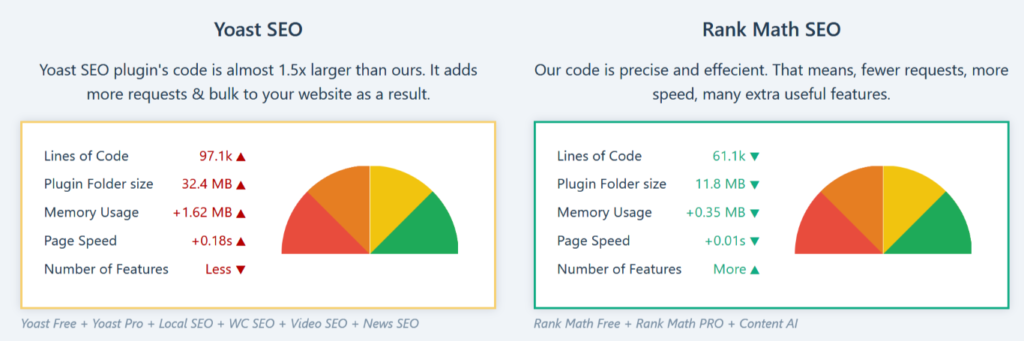
Rank Math wins here, and it’s not particularly close. According to performance tests, Rank Math consumes significantly less memory than Yoast SEO — about 4 times less memory usage. It also adds less load time to your WordPress admin.
One test measured Yoast adding +0.18 seconds to load time, while Rank Math added just +0.01 seconds. Yoast’s memory usage clocked in at +1.62MB versus Rank Math’s +0.35MB. For sites where Core Web Vitals matter (and they always do), these differences add up.
Rank Math is also built with a modular architecture — you can turn off features you don’t need, which keeps the plugin lightweight and focused. Yoast doesn’t offer the same level of modular control, and some users have reported database bloat over time, especially on large sites.
Ease of Use: Which Plugin is More User-Friendly?
Both plugins are designed to be accessible, but they take different approaches.
Yoast SEO is known for its clean, visual interface. The traffic light system — green for good, orange for okay, red for needs work — gives you instant, color-coded feedback on your content. For someone who’s never thought about SEO before, Yoast’s guided setup and straightforward signals make it easy to get started without feeling lost. The onboarding experience is smooth, and the interface rarely overwhelms you.
Rank Math has a setup wizard that many users actually find easier than Yoast’s initial configuration. Once you’re past setup, though, the dashboard is more feature-dense.
There’s simply more to explore — more tabs, more toggles, more options. That’s not a bad thing if you want control, but it can feel like a lot if you’re brand new to SEO.
For complete beginners managing their first WordPress site, Yoast’s simpler interface might feel more comfortable. For anyone with a bit of SEO experience or a strong desire to optimize deeply, Rank Math’s interface gives you more levers to pull.
Content Analysis: How Each Plugin Evaluates Your Posts
Both plugins analyze your content as you write and give you suggestions to improve your on-page SEO. The experience is similar in concept but different in execution.
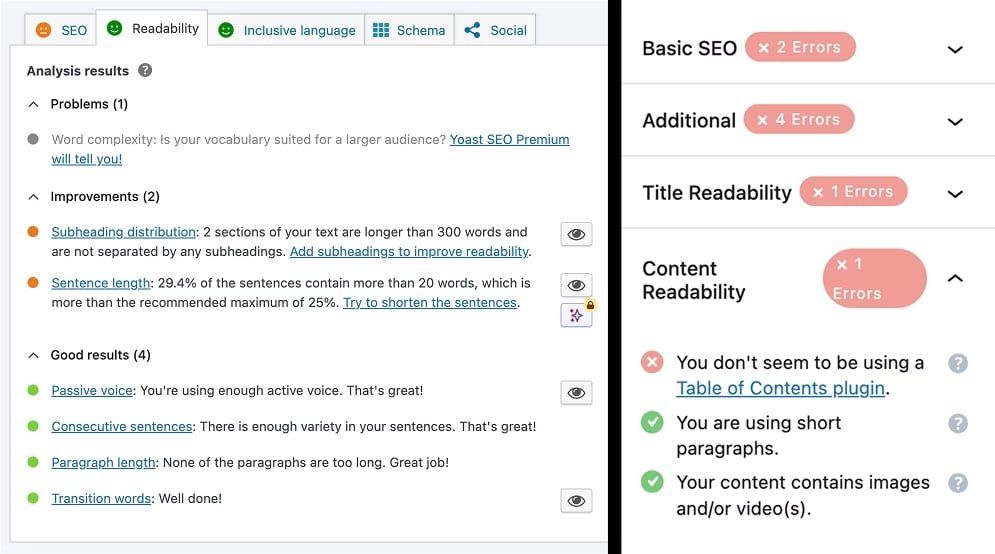
Yoast SEO uses a readability analysis powered by the Flesch Reading Ease score alongside its SEO analysis. It checks sentence length, paragraph length, passive voice usage, transition words, and subheading distribution. The feedback is clear, easy to understand, and genuinely useful for writers who want to make their content more readable.
Rank Math runs its content through 30+ SEO checks, including keyword density, keyword placement in title/URL/meta description/headings/body, image alt text, internal links, external links, and more. Its SEO Score (displayed as a number out of 100) gives you a tangible metric to work toward as you optimize each post.
The key difference: Rank Math’s content analysis is more thorough, while Yoast’s feedback is easier to act on immediately. Both approaches work — it depends on whether you want breadth or simplicity.
WooCommerce SEO: Both Cover the Basics
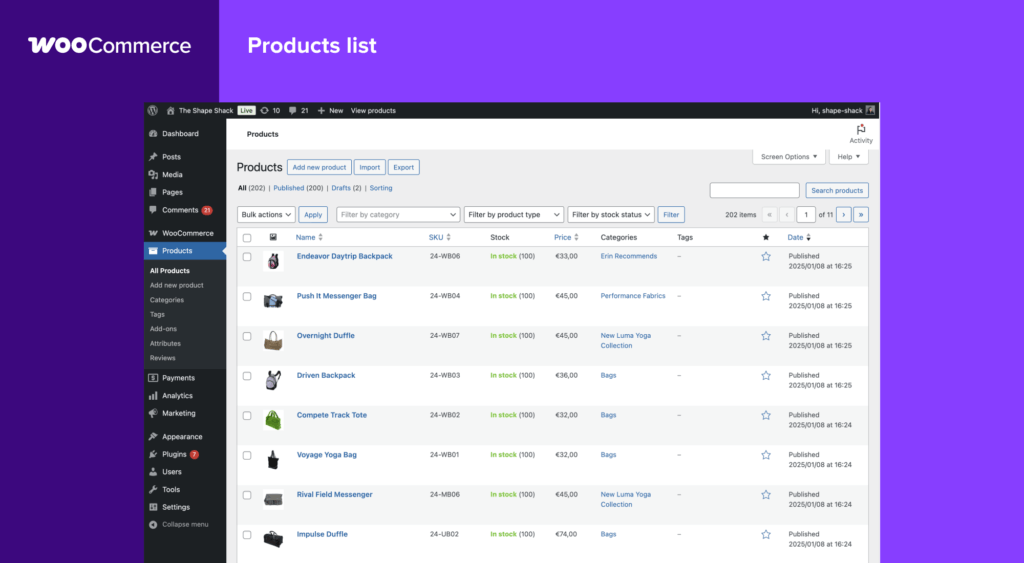
Running an online store on WordPress? Both plugins handle WooCommerce SEO, and both do a solid job of it.
Rank Math’s free version includes basic WooCommerce SEO features — product schema, clean product URLs, and category-based stripping. You can remove the /product-category/ slug from product URLs directly from Rank Math’s free settings, which is a useful SEO tweak that Yoast doesn’t offer for free.
Rank Math Pro takes it further with WooCommerce-specific schema enhancements (GTIN, MPN, brand data), and the Business plan lets you use it across client sites.
Yoast SEO Premium also offers strong WooCommerce integration — product schema, clean URLs, and structured data for product pages. Neither plugin has a decisive edge for eCommerce sites specifically, but Rank Math’s free WooCommerce features give smaller store owners more out of the box.
Google Integration: Data Where You Need It
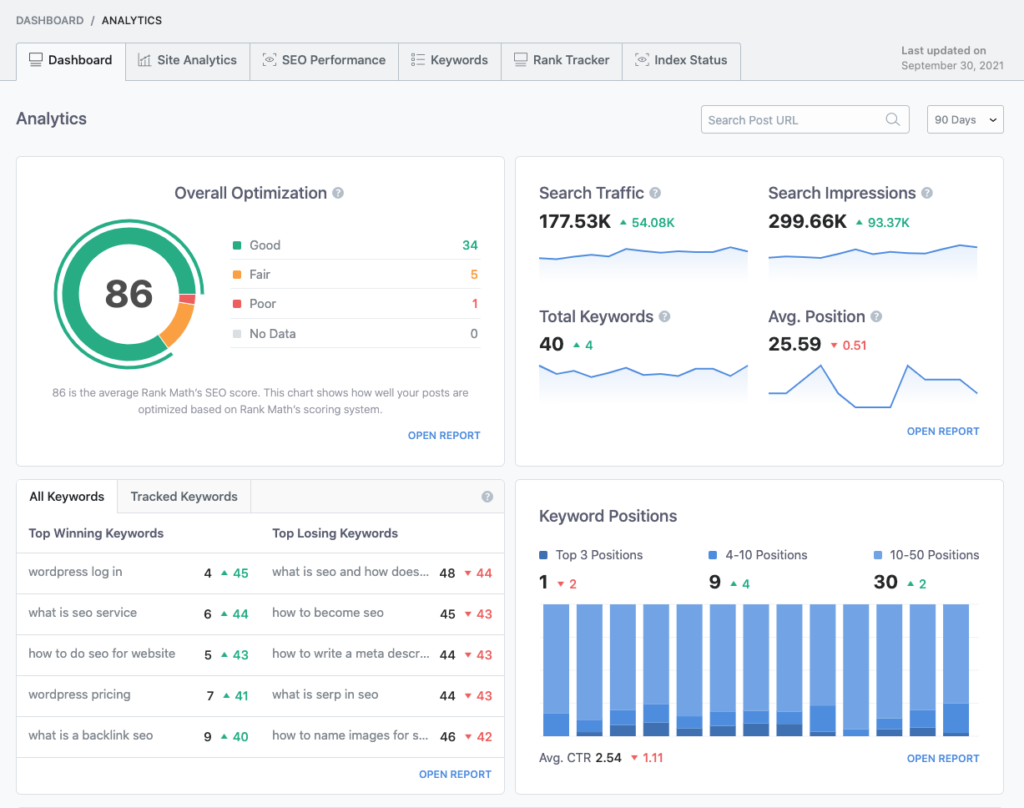
Connecting to Google services — especially Google Search Console — is important for monitoring your SEO performance.
Rank Math includes a native Google Search Console integration in its free version. You can view keyword impressions, clicks, CTR, and position data directly inside your WordPress dashboard without switching tabs or tools. Rank Math Pro also adds full Google Analytics 4 integration and Google Trends data.
Yoast has historically required Site Kit or a separate Google Analytics plugin for this functionality.
However, as of early 2026, Yoast launched a Site Kit by Google integration available to all users, which now brings Google Search Console and Google Analytics data into the Yoast SEO Dashboard. That’s a welcome update — but Rank Math has had native GSC integration since its early days.
Full Feature Comparison: Free Vs Paid
Here’s a comprehensive side-by-side look to make your decision easier
| Category | Rank Math | Yoast SEO | Winner |
|---|---|---|---|
| Free Focus Keywords | 5 per post | 1 per post | Rank Math |
| Free Schema Markup | 15+ types | Basic only | Rank Math |
| Free Redirections | Yes | No | Rank Math |
| Free 404 Monitor | Yes | No | Rank Math |
| Free GSC Integration | Yes | No (now via Site Kit) | Rank Math |
| Content Analysis Depth | 30+ checks | 12+ checks | Rank Math |
| Readability Analysis | Yes | Yes (more detailed) | Yoast |
| Site Performance Impact | +0.01s / +0.35MB | +0.18s / +1.62MB | Rank Math |
| Beginner Interface | Moderate | Very easy | Yoast |
| Pro Price (1 site) | $84/year | $118.80/year | Rank Math |
| Built-in Analytics (Pro) | Yes | No | Rank Math |
| Keyword Rank Tracking | Yes (Pro) | Via Wincher (Pro) | Rank Math |
| Google Docs Integration | No | Yes (Premium) | Yoast |
| Schema Customization | Advanced (Pro) | Basic | Rank Math |
| WooCommerce SEO | Free + Pro | Premium | Rank Math |
| Active Installations | 4M+ | 10M+ | Yoast |
| User Rating (WordPress.org) | 4.9 stars | 4.8 stars | Rank Math |
| Agency/Multi-site Plans | Yes | Bulk discounts | Rank Math |
Who Should Use Rank Math?
Rank Math is the better choice if you:
- Want maximum features without paying — including redirects, schema, 404 monitoring, and multi-keyword tracking
- Run a content-heavy site and need deep content analysis
- Manage WooCommerce stores and want product SEO features at no extra cost
- Are building or managing multiple sites (Business/Agency plans)
- Care about site speed and want a lighter plugin footprint
- Want built-in analytics without third-party integrations
- Have some SEO experience and want more control over your optimization
Who Should Use Yoast SEO?
Yoast SEO is the better fit if you:
- Are a complete beginner who wants simple, visual, color-coded feedback
- Primarily focus on content readability and want detailed writing guidance
- Work with a content team that writes in Google Docs (Yoast’s Google Docs integration is unique)
- Are on a site where familiarity matters — Yoast’s interface is widely known and documented
- Want a trusted, long-established plugin with over a decade of proven reliability
- Prefer a more guided, hand-holding SEO experience
How to Switch from Yoast to Rank Math
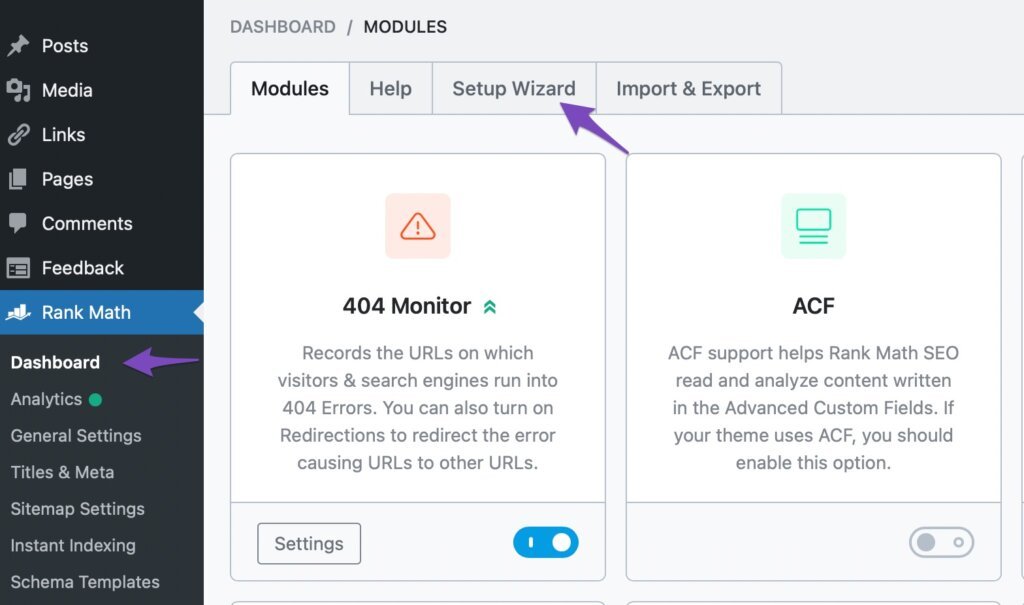
If you’re currently using Yoast and want to try Rank Math, the migration process is straightforward. Rank Math includes a built-in importer that pulls all your existing Yoast SEO data — meta titles, descriptions, settings, and more — with one click.
The process involves installing Rank Math, running the import wizard, configuring your settings, and then deactivating Yoast. After migrating, clear your cache and resubmit your XML sitemap to Google Search Console to ensure everything updates cleanly.
The Bottom Line: Which One Wins in 2026?
On value and features alone, Rank Math wins — and it’s not particularly close. More free features, better schema support, faster performance, deeper content analysis, and a lower price for the paid version.
But SEO tools aren’t just about feature lists. They’re about what you’ll actually use consistently. If Yoast’s simplicity means you’ll optimize every post rather than getting overwhelmed and skipping it, then Yoast is the right tool for you.
For WordPress developers, agencies, eCommerce store owners, and experienced content managers: Rank Math is the smarter choice in 2026. It gives you more to work with, wastes fewer resources, and costs less to unlock the full experience.
For beginners, solo bloggers, and teams who need the simplest possible workflow: Yoast SEO remains a solid, proven option that will not steer you wrong.
Get More From Your SEO Plugin With Expert Guidance
Knowing which plugin to install is just one piece of the SEO puzzle. Getting it configured correctly, using it to its full potential, and building an SEO strategy around it — that’s where real rankings are won.
Khalid Hussain, founder of SEO Visibility, is a freelance SEO expert and top-rated SEO partner with 15+ years of experience who has helped 999+ businesses, agencies, and eCommerce stores grow online.
Whether you’re migrating from Yoast to Rank Math, setting up technical SEO from scratch, or looking to build a content strategy that actually drives traffic, Khalid brings the kind of hands-on expertise that turns plugin settings into real-world results.
Ready to stop guessing and start ranking? Work with Khalid at SEO Visibility and get a proven SEO strategy built around your goals.



![How Much Does an SEO Expert Cost in 2026 [SEO Pricing]](https://seovisibility.co/wp-content/uploads/2026/01/how-much-does-an-seo-expert-cost.png)





![SEO Copywriting Checklist [Easy to Follow Guidelines]](https://seovisibility.co/wp-content/uploads/2026/01/seo-copywriting-checklist.png)