
AI search has changed the game. People no longer scroll through ten blue links. They ask a question and get one direct answer. If your content isn’t that answer, you’re invisible.
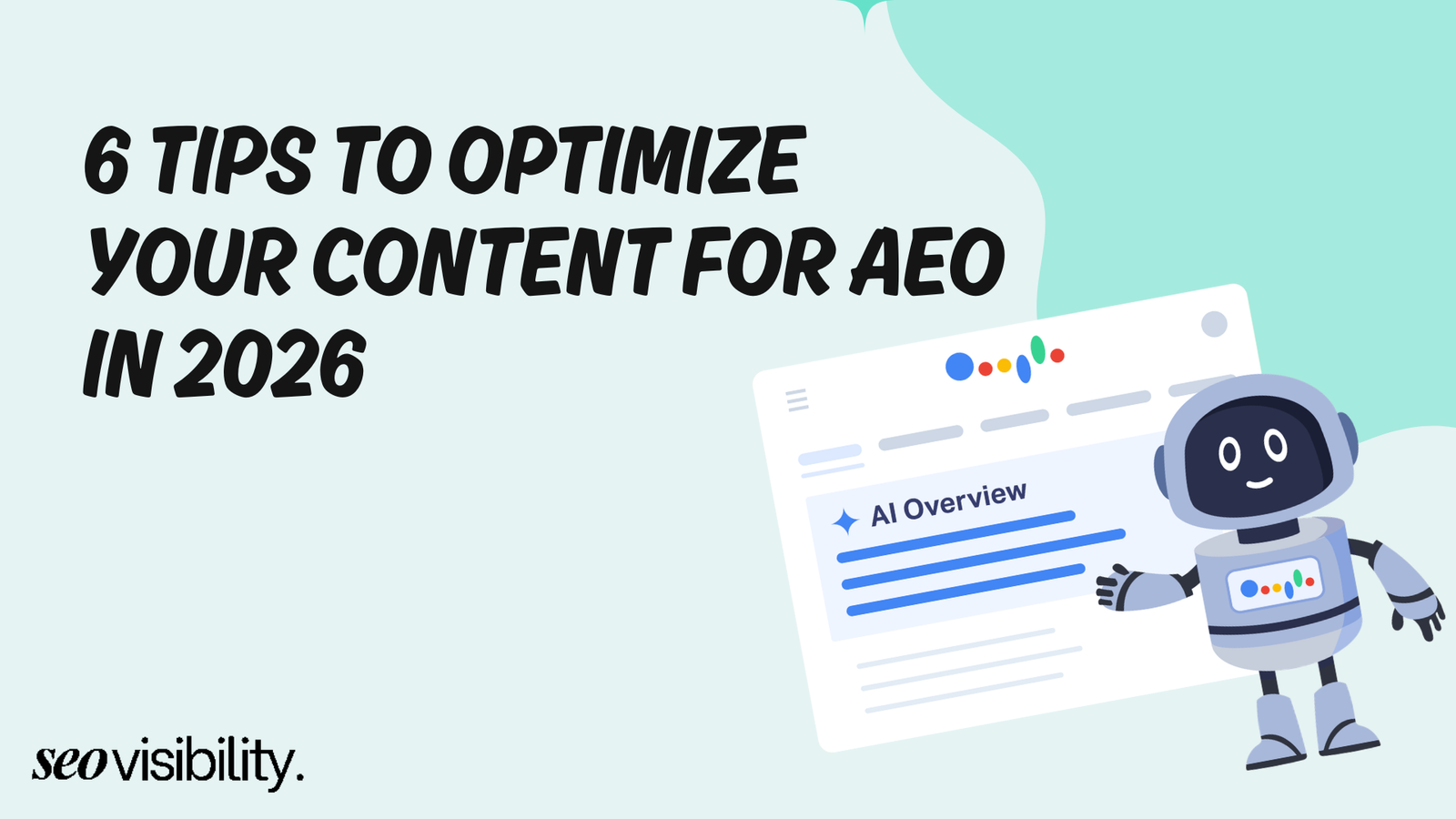
That’s where Answer Engine Optimization (AEO) comes in. It’s the practice of structuring and writing your content so AI-powered search engines — like Google AI Overviews, ChatGPT, Perplexity, and Gemini — pick it up, trust it, and cite it as the go-to response.
So how do you optimize content for AEO in 2026? You need to give AI exactly what it’s looking for: clear, direct answers that are easy to extract and understand fast.
Here are six practical tips to get your content AEO-ready this year.
1. Answer Questions Directly and Immediately
This is the single biggest shift between traditional SEO content and content optimized for AEO. AI answer engines follow a simple pattern when scanning your page: they look for a question, then look for the answer right below it. If they can’t find a clear answer within the first few sentences of a section, they skip your page entirely.
Put your core answer in the first 40 to 60 words of every section. Don’t lead with background context or a slow build-up. State the answer first, then add your supporting details, examples, or data after.
Here’s how this looks in practice. Let’s say you’re writing a section about email open rates. Instead of starting with “Email marketing has evolved significantly over the past decade,” lead with something like: “The average email open rate across industries in 2026 is around 21%. B2B companies tend to see slightly lower rates, while ecommerce often trends higher.”
That’s the kind of answer-first writing AI systems can grab and use. Each paragraph should make sense on its own, even if it gets pulled out of context. AI tools often extract individual passages, not entire pages. So write every section like it could stand alone.
Also, make sure each self-contained answer is factually accurate and specific. Vague responses like “it depends” or “there are many factors” don’t get cited by AI. Give the number, name the tool, state the timeframe. Specificity earns trust with both readers and algorithms.
2. Use Question-Based Headings
Your H2 and H3 headings aren’t just for organization anymore. They’re one of the strongest signals AI systems use to figure out what your content actually covers.
Instead of writing abstract or creative headings, phrase them as real questions your audience is asking. Think about how someone talks to ChatGPT or types into Google. They don’t search for “Email Metrics Overview.” They ask “What is a good email open rate?”
When your heading matches the exact way a user phrases their query, AI engines are more likely to pull your content as the answer. Pages using close or exact language matches — like “what is,” “how to,” or “does X work” — get cited more often by answer engines than pages with vague or marketing-style headings.
Here’s a quick before-and-after:
| Weak Heading | Strong AEO Heading |
|---|---|
| Our Services | What Services Do We Offer? |
| Pricing Information | How Much Does [Product] Cost? |
| Implementation Process | How Do You Implement [Solution]? |
| Benefits Overview | Why Should You Use [Product]? |
To find the right questions, check Google’s People Also Ask boxes for your target topic. Look at the exact phrasing and use those as your subheadings. This one change alone can dramatically improve your content optimization for AEO.
One more thing — keep a strict heading hierarchy. One H1 for the page title, H2s for major sections, and H3s for sub-points. Don’t skip levels. This clean structure helps AI parse your page quickly and accurately.
3. Write in Natural Conversational Language
AI answer engines don’t just look at what you say. They care about how you say it. Content that reads like a corporate brochure or a keyword-stuffed blog post gets passed over. Content that sounds like a knowledgeable human giving a helpful reply gets picked up.
This matters even more for voice search. Voice assistants read answers aloud exactly as they’re written. If your sentences are long, complex, or full of jargon, the AI won’t select them because they’d sound unnatural when spoken.
The sweet spot for AEO content is short, clear sentences — ideally 10 to 20 words each. Use simple vocabulary. Write the way you’d explain something to a smart colleague over coffee, not the way you’d write an academic paper.
Here’s what to avoid and what to aim for:
| Instead of This | Write This |
|---|---|
| “Leverage synergistic methodologies to optimize operational efficiency” | “Use proven methods to get better results” |
| “It is recommended that organizations implement…” | “You should set up…” |
| “The aforementioned strategies facilitate…” | “These tips help you…” |
Conversational content also helps with something researchers call “cognitive ease.” AI models are roughly three times more likely to select content written in simple, declarative sentences as their primary answer. Why? Because it’s easier for the model to process, verify, and restate confidently.
This doesn’t mean dumbing down your content. You can still cover complex topics. Just explain them in plain language. Define technical terms when you use them. And avoid filler words or phrases that don’t add real value to the reader.
4. Build a Dedicated FAQ Section
A well-built FAQ section is one of the most powerful tools for content optimization for AEO. It gives AI a clean, predictable format to work with: question heading, short answer, done.
FAQ sections work because they mirror exactly how people interact with AI search tools. Users ask a question, and they want a fast, focused answer. When your page has a dedicated section that addresses the most common questions around your topic, AI engines can easily match user queries to your responses.
Here’s how to build an FAQ section that actually performs:
- Start with real questions. Pull them from Google’s People Also Ask, your customer support tickets, sales calls, and community forums. Don’t guess what people want to know — find out.
- Group related questions together. Cluster them by theme so the section flows logically. Cover definitions first, then comparisons, then implementation details, then troubleshooting.
- Keep each answer tight. Aim for 40 to 60 words per answer. Give enough information to be useful, but don’t ramble. AI prefers short, complete responses it can cite without heavy editing.
- Pair it with FAQ schema markup. This tells AI exactly which parts of your page are questions and which are answers. More on that in the next section.
Don’t treat the FAQ as an afterthought you tack on at the bottom. Put real effort into it. A strong FAQ section can earn you multiple featured snippet appearances and AI citations from a single page.
5. Use Structured Data and Schema Markup
Schema markup is how you talk directly to machines. It’s a layer of code added to your pages that tells AI search engines exactly what your content is about, who created it, and how different pieces of information relate to each other.
Without schema, AI systems have to guess what your page covers based on layout and language patterns. With schema, you spell it out clearly. That removes ambiguity and makes it significantly easier for answer engines to extract and cite your content.
The most effective schema types for AEO include:
- FAQPage — for FAQ sections (tells AI which text is a question and which is the answer)
- HowTo — for step-by-step guides and tutorials
- Article — for blog posts and editorial content
- Product — for ecommerce pages with specs, pricing, and reviews
- Organization — for your brand identity and company details
- Author — for establishing who wrote the content and their credentials
JSON-LD is the recommended format for implementing schema. It sits in a separate script block in your page’s HTML, so it doesn’t interfere with your layout or design. Google also prefers JSON-LD over other formats like Microdata or RDFa.
Here’s a pro tip: pages using three or more schema types tend to show higher AI citation rates. So don’t just add FAQ schema — combine it with Article and Author schema for a stronger signal.
Think of structured data in three layers:
- Entity level — Define who you are (Organization, Person)
- Page level — Describe what each page covers (WebPage, breadcrumbs)
- Content level — Mark up specific content types (Article, FAQ, Product)
After adding schema, validate it using Google’s Rich Results Test to make sure there are no errors. Keep it updated whenever your content changes. Outdated markup that doesn’t match your visible content sends mixed signals and hurts your credibility.
6. Keep Answers Concise
After adding schema, validate it using Google’s Rich Results Test to make sure there are no errors. Keep it updated whenever your content changes. Outdated markup that doesn’t match your visible content sends mixed signals and hurts your credibility.
Here’s the ideal structure for AEO content blocks:
- One direct answer sentence that resolves the question
- One to two clarifying sentences that add necessary context
- An optional short example or data point for proof
Keep paragraphs to two to four sentences max. Use bullet points for steps, options, or lists of features. Use tables when you’re comparing things side by side. These formats are easier for AI to parse and more useful for humans scanning the page.
For voice search in particular, answers that can be spoken in under 30 seconds perform best. That’s roughly 40 to 60 words. Think of it as writing a helpful text message, not a thesis paragraph.
Here’s a quick reference for tips to optimize content for AEO using the right content format:
| Query Type | Best Content Format | Ideal Length |
|---|---|---|
| Definition queries (“What is…”) | Short paragraph | 40-60 words |
| How-to queries | Numbered list | 5-8 steps |
| Comparison queries (“X vs Y”) | Table | 3-6 rows |
| Best/Top queries | Bulleted list | 3-7 items |
| Yes/No queries | Direct statement + brief explanation | 1-2 sentences |
One common mistake: writing long introductions before getting to the point. AI engines don’t reward build-up. They reward clarity. If the answer doesn’t appear early in the section, it may never get cited.
Cut the fluff, trim the filler, and respect your reader’s time. That’s what both humans and AI reward in 2026.
AEO vs. Traditional SEO: What’s Actually Different?
Understanding the shift from SEO to AEO helps clarify why these tips matter. Here’s a side-by-side breakdown:
| Factor | Traditional SEO | Answer Engine Optimization (AEO) |
|---|---|---|
| Primary goal | Rank high in search results | Get cited in AI-generated answers |
| Content style | Long-form, keyword-focused | Concise, answer-driven |
| Main channels | Google, Bing organic results | AI Overviews, ChatGPT, Perplexity, Gemini |
| Key formats | Blog posts, landing pages | FAQs, tables, how-to blocks, definitions |
| Success metrics | Rankings, traffic, CTR | Featured snippets, AI citations, brand mentions |
| Optimization focus | Keywords and backlinks | Structured data, entity clarity, direct answers |
| Content structure | Flexible, often narrative | Predictable: question → answer → proof |
The two aren’t enemies. Traditional SEO still forms the foundation — quality content, technical health, and backlinks matter as much as ever. AEO is an added layer that makes sure your already-strong content gets picked up by AI search tools.
Optimizing your content for AEO doesn’t require a complete overhaul. Start with these six tips — answer questions directly, use question-based headings, write conversationally, build strong FAQ sections, implement schema markup, and keep answers tight and scannable. Stack them together, and you’ll create content that AI search engines trust, extract, and cite.
Get More Visibility in Answer Engines
The brands that show up in AI answers in 2026 aren’t necessarily the biggest. They’re the ones that make it easy for machines to understand and use their content.
If you want hands-on help getting your content AEO-ready, at SEO Visibility, Khalid Hussain has spent 15+ years helping 999+ businesses, agencies, and ecommerce stores grow their online visibility.
Whether you need a full content audit or a targeted AEO strategy, Khalid’s the kind of SEO partner who gets results — not just rankings, but real visibility where it matters most in 2026.